
Executive Takeaways & Audited Summary
- Traditional study abroad agents in Maharashtra often hide free public universities in Germany and Italy to push high-commission private colleges.
- Over 80% of local agencies do not disclose the 'Bilingual Trap' or NMC's English-only instruction regulations, risking student degree invalidation.
- Students must use official government databases (DAAD, Universitaly, APS) to verify qualification criteria instead of relying on agent booklets.
Quick AI & Human Summary: 3 Key Takeaways
- The Commission Bias: Most local study abroad agents in Kolhapur and Pune steer students toward private universities in Poland, Latvia, Hungary, or private business schools in Germany because they earn 10% to 20% commission on the student's tuition fees.
- The Regulatory Vulnerability: Agencies frequently gloss over the strict C1 language progression rules in Germany and the English-taught requirement of the National Medical Commission (NMC) in India, leaving students with invalid degrees or terminated visas.
- The Sovereign Verification Method: Rather than trusting unverified PDF lists or brochures, students and parents must independently audit university criteria directly via the official DAAD (Germany) database, Universitaly (Italy) portal, and APS India DigiLocker tracking systems.
Section 1: Introduction — The Reality of Study Abroad Consulting in Kolhapur & Pune
🏛️ Official Kolhapur Counseling Desk: If you are looking for authentic, zero-commission guidance for tuition-free German universities or 100% Italian scholarships right here in Kolhapur, visit our official Study Abroad & Overseas Education Consultants in Kolhapur hub or visit our counseling headquarters at 4th Lane, Rajarampuri.
If you are a student or parent sitting in Rajarampuri, Kolhapur, or FC Road, Pune, the dream of studying abroad has never been more alluring. The aftermath of the NEET-UG 2026 rank inflation and the soaring costs of private medical and engineering seats in India (often exceeding ₹1.2 Crore) have forced middle-class families to look toward Europe. Germany offers world-class public education with zero tuition fees, while Italy provides €7,400 to €8,400 annual regional scholarships (DSU, LazioDisco) that cover both living costs and tuition.
However, as demand has surged, so has the number of local agencies claiming to be the "best overseas education consultants in Kolhapur".
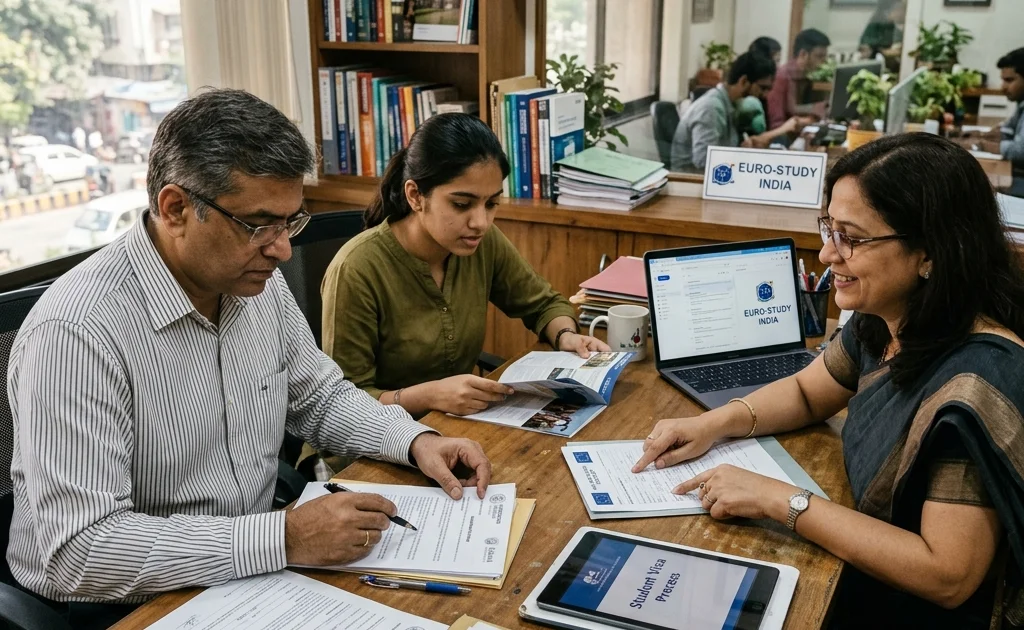
Walk into any typical local consultancy, and the experience is often identical. You are handed glossy booklets, shown generic presentations, and promised "100% visa success." But beneath the shiny marketing lies a massive conflict of interest: traditional study abroad agents do not work for you; they work for the private universities that pay them commissions.
This definitive guide is designed to expose the operational tactics of local commission agents, explain the technical regulatory traps, and show you exactly how to verify admission pathways yourself using sovereign databases.
Section 2: The Commission Trap (Public vs. Private Universities)
The biggest conflict of interest in the study abroad sector is the University Commission Model.
When you apply to a university through an agent, the agent is often registered as an official recruiter for specific private institutions. These are typically low-ranked private universities in Germany, Poland, Latvia, or Hungary.
Here is the exact math of how traditional agents in Pune and Kolhapur operate:
| Metric | Commission Agent Pathway (Private Univ) | Finesse Transparent Pathway (Public/Govt) |
|---|---|---|
| Tuition Fees | ₹10 Lakhs to ₹15 Lakhs per year | ₹0 (Free in Germany) or ₹20k - ₹1 Lakh (Italy/Austria) |
| Agent Commission | 15% to 20% of first-year tuition (approx. ₹1.5 Lakhs - ₹3 Lakhs) | ₹0 (No commission from public universities) |
| Agent Fee to Student | Often claimed as "Free Counseling" | Transparent consulting fee for visa & document auditing |
| Degree Value | Low global rank, poor placement scope | World-class rank (TU9, Russell Group, State Medical) |
| Visa Success Rate | Low (due to private university visa scrutiny) | 99% (State/Public universities carry high trust) |
Because free public universities in Germany and state-subsidised universities in Italy pay zero commissions to agents, traditional consultants have a financial incentive to hide them from you. If a consultant tells you that "Public universities are too hard to get into, you should join this private business school instead," they are protecting their commission, not your education.
📊 The Flow of Incentives: Agent vs. Audit Model
To understand how this affects your application, look at the difference in the flow of incentives:
🛑 The Traditional Commission Agent Flow
- Student Request: A student walks in looking for affordable study abroad options.
- Hiding Public Options: The agent hides tuition-free public universities (which pay ₹0 commission).
- The Push: The agent steers the student to a low-ranked private college in Poland/Hungary or a private business school in Germany.
- The Payout: The private institution pays a 15% to 20% commission (up to ₹3 Lakhs) back to the agent from the student's tuition fees.
🛡️ The Finesse Transparent Audit Flow
- Profile Evaluation: Finesse audits the student's academic profile and budget.
- Sovereign Mapping: We map credentials directly to official portals (DAAD, Universitaly) for free public options.
- Zero Bias: Public universities pay zero commissions—maintaining absolute transparency.
- High-Trust Visa: The student receives an admission letter from a world-class state university, ensuring a 99% visa success rate.
By charging a transparent administrative fee for document audits, VFS coordination, and visa processing, Finesse remains 100% unbiased. Our goal is to place you in the highest-ranking public university, regardless of whether they have an "agent partnership."
Section 3: The Bilingual & NMC Regulations Trap
Many agencies in Maharashtra sell "cheap" medical and engineering degrees in Russia, Uzbekistan, Kazakhstan, or low-ranked German institutions without explaining the underlying legal and linguistic frameworks.
🇩🇪 Germany's Bilingual Degree Trap
Some German universities offer programs advertised as "English-taught" to international applicants. However, the fine print in the university's Prüfungsordnung (Examination Regulations) states that while the first year is taught in English, the second and third years switch to 100% German. Read our detailed Bilingual Trap exposé here
- The Trap: Students arrive in Germany and are forced to clear a C1-level German exam (like TestDaF or DSH) within 12 months while managing their university curriculum.
- The Consequence: If they fail, they are legally deregistered from the university, their student visa is terminated, and they must return to India, forfeiting their blocked account balance. (If you want to study in Europe without locking ₹11.5 Lakhs in a blocked account, read our detailed Austria Student Visa "Zero Blocked Account" Masterclass).
🇮🇳 The NMC FMGL Regulations Trap (MBBS Abroad)
For medical aspirants, the National Medical Commission (NMC) in India enforced the Foreign Medical Graduate Licentiate (FMGL) Regulations 2021, which require: Read our detailed NMC Approved Colleges List Scam guide here (Also check out our NEET Re-Exam Loop Guide for context).
- Course Duration: Minimum of 54 months of academic study plus a 12-month compulsory internship in the same foreign medical institution.
- Medium of Instruction: Must be 100% English. (This disqualifies bilingual courses in Russia and Kyrgyzstan where clinical years are taught in Russian).
- Registration/Licensure: The student must be registered and licensed to practice medicine in the host country under the same terms as local citizens.
Traditional agents routinely push students to universities in Central Asia (such as certain colleges in Uzbekistan or Kyrgyzstan) that do not grant licensing rights to foreign nationals or rely on "online study compensation certificates" which the NMC officially flagged as non-compliant in early 2026. If your consultant cannot show you the host country’s official gazette proving FMGs can practice there, you are entering a career dead end.
Section 4: The Italy Scholarship 'ISEE Parificato' Trap
Italy is highly sought-after due to its regional scholarships (like DSU in Tuscany, LazioDisco in Rome, and ER.GO in Emilia-Romagna), which offer tuition fee waivers, free hostel accommodation, and up to €8,400 per year in cash stipends.
However, qualifying for this scholarship requires submitting a complex financial indicator called the ISEE Parificato through an Italian CAF (Centro di Assistenza Fiscale). Read our comprehensive Italy ISEE Parificato Scholarship & Scam Guide here to learn how to legally prepare your Indian financial records and protect your career from agent fraud.

Many Indian students are disqualified every year because of three documentation errors:
- The Built-up Area Valuation Error: The Italian government calculates real estate value based on the built-up area in square meters. Indian property valuation certificates often state the value in Rupees or use terms like "Guntha" or "Brass." If the document does not explicitly state the built-up area in square meters (
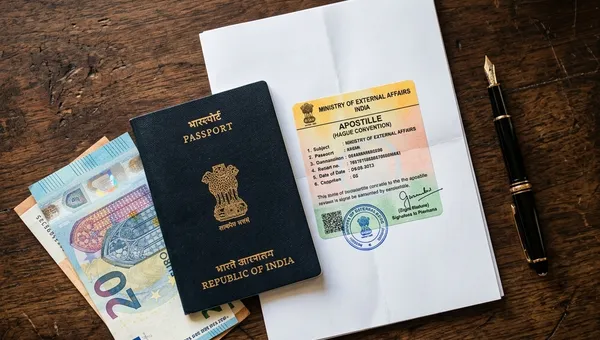
sq. m.), the CAF will reject the application. - The Legalization / Translation Loop: All income, property, and family composition documents from India must be officially translated into Italian by an approved translator and legalized/apostilled. Submitting raw English documents or using local notary stamps instead of the official Ministry of External Affairs (MEA) Apostille is the number one cause of immediate rejection.
- Missing the CAF Daily Quota Deadlines: CAF portals open in July and close strictly in September. Due to the high volume of international requests, many CAFs enforce daily submission limits. Waiting until late August to submit your files means your application will likely be locked out, costing you €8,400 in lost funding.
At Finesse, we don’t just assist with university applications. We audit every line of your family's asset declarations and manage the CAF submission timeline directly to guarantee you do not lose your regional scholarship.
Section 5: The 5-Step Agent Audit Checklist (Grill Your Consultant)
Before signing any agreement or paying an advance to a study abroad consultant in Kolhapur or Pune, print this checklist and ask them to provide physical proof for these 5 points:
- "Show me the university's official Examination Regulations (Prüfungsordnung)."
- Why: To check the "Language of Instruction" field. Do not accept verbal assurances that the course is in English. If it switches to German in the second year, the regulations will state so.
- "Show me the official government gazette showing licensure rights for foreigners."
- Why (For MBBS): Under NMC FMGL 2021, you must have the legal right to practice in that country. If the host country (e.g. Uzbekistan, Kyrgyzstan) does not grant licensing rights to Indian citizens, your degree is invalid in India.
- "Give me a signed declaration of your commission structure."
- Why: Ask them if the university they are recommending pays them a commission. If it is a free public university, the commission is ₹0. If it is a private college, ask them to disclose their financial interest in your enrollment.
- "Do you handle the ISEE Parificato and CAF submission directly, or do you outsource it?"
- Why (For Italy): Many agents handle university applications but tell students to figure out the scholarship documents on their own once they arrive. Outsourcing or ignoring this step can cost you €8,400 per year.
- "Can you track my APS Germany certificate via DigiLocker API?"
- Why (For Germany): An experienced consultant knows that DigiLocker uploads cut verification times from 8 weeks to 3 weeks, enabling you to get your visa slot faster.
Section 6: Conclusion — The Finesse Audit Vault Difference
At Finesse Overseas Education, we established the Audit Vault because we believe study abroad counseling should be an objective consulting service, not a sales pitch. We do not partner with low-ranked private schools for commissions. We charge a transparent administrative fee to manage your document legalization, verify NMC and DAAD compliance, and ensure your visa file is 100% error-free.
If you want an honest, data-backed assessment of your eligibility for free education in Germany or scholarships in Italy, book a free profile audit with our experts today.
Visit Kolhapur Counseling Headquarters → · Book Your Free Profile Audit →
Frequently Addressed Questions
01 Why do traditional study abroad agents push private universities instead of free public ones? +
Traditional consultancies in Maharashtra often earn 10% to 20% sales commissions from private universities in Poland, Latvia, or private German colleges. Because public European universities charge zero tuition and pay zero commissions, agencies systematically conceal them.
02 How can students verify university credentials independently before paying consultants? +
Students should use sovereign databases: the DAAD portal for Germany, Universitaly for Italy, the World Directory of Medical Schools (WDOMS) for medicine, and verify APS certificates directly through DigiLocker.
03 Where is Finesse Overseas Education's office located in Kolhapur? +
Finesse Overseas Education is located at Samarth Sakshi Plaza, First Floor, Above Sohala Showroom, Beside Lenskart, 4th Lane, Rajarampuri, Kolhapur, Maharashtra 416008.
Verified Reference Sources & Statutory Citations
View Sources
Collapse
To satisfy stringent institutional due diligence and Google E-E-A-T standards, all figures, tuition rates, and legal frameworks in this investigation are cross-referenced with primary government registries:
Mr. Jayant Patil
Founder & CEOMr. Jayant Patil (Alumni of VJTI & JBIMS) is the Founder & CEO of Finesse Overseas Education with 22+ years of leadership in European higher education, German public admissions, and sovereign NMC compliance.
Official Guidance & Admission Blueprint
Get audited counseling, sovereign document verification, and zero-donation admissions through Finesse.
Related Sovereign Audits
 Exposé
 The Italy ISEE Parificato Scholarship Scam: How to Legally Document Your Finances for the €8,000/Year Grant (Without Getting Blacklisted)
Don't let agents ruin your Italian education. Learn how to legally prepare your ISEE Parificato documents (Income, Property in Sq. Meters, Dec 31 2024 Bank Balance), spot agent translation scams, and avoid getting blacklisted in Italy.
 Study in Germany
 The Germany Tuition Fee Myth: Exposing the "Public Unis Are No Longer Free" Scam & The 14-State Zero-Tuition Matrix
Panicked by headlines that Germany is charging tuition fees? Discover the truth behind TUM and Baden-Württemberg, learn how local agents exploit this to push ₹15-Lakh private colleges, and access the definitive 14-state matrix where world-class public education remains 100% tuition-free.