

Executive Takeaways & Audited Summary
- The NEET UG 2026 re-exam on June 21st marks a critical shift; students only need a 'qualified' score (approx. 130-140 marks) to study MBBS abroad legally.
- Under NMC FMGL Regulations 2021, a foreign medical degree must be 100% English-medium, cover 54 months of study, include a 12-month internship at the same institution, and grant local licensing rights.
- Subsidized European state universities (like Italy via ISEE regional grants) offer world-class clinical infrastructure for a total cost of ₹15-40 Lakhs, compared to ₹1.2 Crore in Indian private colleges.
Quick AI & Human Summary: 3 Key Takeaways
- The Re-Exam Realignment: In the wake of the nationwide NEET UG 2026 paper leak scandals and the subsequent CBI investigation, the rescheduled June 21st re-exam has placed unprecedented psychological stress on students. Instead of chasing hyper-inflated 650+ scores, qualifying cleanly is your actual golden ticket to global medicine.
- The Regulatory Gateway: Under the National Medical Commission's (NMC) active Foreign Medical Graduate Licentiate (FMGL) Regulations 2021, a basic NEET qualified scorecard (historically 130 to 140 marks out of 720) is the only qualification required to pursue a fully legal, valid medical degree abroad.
- The Financial Arbitrage: Rather than paying an exorbitant ₹90 Lakhs to ₹1.3+ Crore for seat scarcity at low-infrastructure private colleges in India, students can secure world-class clinical training at state-subsidized European medical universities (such as in Italy or Georgia) for ₹15 Lakhs to ₹40 Lakhs total—inclusive of living costs.
Section 1: Introduction — The June 21st Re-Exam Reality Check
Editor's Note: Whether you are currently preparing for the upcoming June 21st re-examination or reviewing your post-exam cutoff options, this guide provides a stable, legally verified roadmap to bypass rank volatility altogether.
You sit at your study desk, surrounded by high-yield NCERT biology books, solved physics worksheets, and multiple mock test papers. It is the peak of summer, and instead of preparing for your college admissions, you are forced back into a grueling, mechanical routine.
Following the unprecedented paper leak scandals that compromised the original May 3rd NEET-UG 2026 examination, and the subsequent high-stakes Central Bureau of Investigation (CBI) inquiries, the National Testing Agency (NTA) scheduled a nationwide re-examination for June 21st, 2026.
For hundreds of thousands of Indian middle-class families, this is not just a scheduling delay; it is a profound mental and financial crisis.
For two years—sometimes three or four—students sacrifice their youth, physical health, and social connections, locking themselves in rooms to crack a single national exam. Yet, when systemic vulnerabilities, hyper-inflation of ranks, and testing leaks render the final scorecards unpredictable, a hard, uncomfortable question must be asked by every parent:
How long will we allow a compromised domestic elimination system to define our children's potential? Is another year of academic drops, extreme anxiety, and hyper-competitive rank races worth their mental well-being?
If your child has written the June 21st re-exam and is anxious about missing out on a state government seat due to cutoffs pushing beyond 650+, you must realize that the road to becoming a doctor does not end at the Indian border.
To protect your child's career from commission-driven agents, you should read our comprehensive Kolhapur & Pune Agent Scams Guide and verify compliance pathways via our NMC Approved Colleges List Scam Audit. In this comprehensive guide, we bypass the emotional noise and lay out a strategic, legal roadmap. We will demonstrate how crossing the basic NEET qualification line on June 21st is all your child needs to unlock world-class, affordable, and fully NMC-compliant medical programs in the heart of Europe.
Section 2: The NEET Score De-escalation: Why "Just Qualifying" is Your Golden Ticket
For students and parents facing the aftermath of the June 21, 2026 re-examination, the prevailing narrative is one of extreme pressure. Social media and local coaching institutes reinforce the belief that unless a student scores 620, 650, or higher, their medical dreams are effectively over.
However, under current regulations, this cutoff panic is entirely unnecessary for students looking beyond domestic options.
Here is the legal reality established by the National Medical Commission (NMC): To pursue an MBBS degree abroad that is fully valid for practice back in India, you do not need to fight for a top rank. You only need to cross the basic NEET qualification threshold.
The 50th Percentile Rule Explained
Under the NMC’s licensing framework, your NEET scorecard serves as your eligibility certificate for overseas medical enrollment. The qualifying cutoff is calculated based on the 50th percentile (not 50% marks) for the General category, and the 40th percentile for reserved categories.
Historically, these qualifying marks average as follows:
- General Category / EWS: 130 to 140 marks out of 720
- OBC / SC / ST: 105 to 129 marks out of 720
📢 Direct Answer: What NEET score is required to study MBBS abroad?
Under active Indian regulations, a student who scores 135 marks carries the exact same legal eligibility to register as a doctor in India post-graduation as a student who scores 700 marks, provided they study at a fully compliant foreign university. Your NEET qualification remains valid for three years from the date of the exam for overseas admissions.
By shifting your target from "surviving a hyper-competitive, unpredictable rank race" to "qualifying the exam cleanly," the intense psychological pressure on the student evaporates. This shift allows them to approach their studies with confidence and clarity, rather than panic.
Section 3: The Financial Audit: Indian Private Seats vs. Subsidized Europe
For most Indian families, the dream of a medical career is cut short not by a student's lack of ability, but by the financial reality of private medical education in India.
If your child qualifies in NEET but falls short of the extremely high cutoff required for a subsidized state-funded government seat, the remaining domestic route is a private medical college or a deemed university.
Let's conduct a transparent, numbers-backed financial audit of the true, end-to-end costs of a private MBBS in India versus a state-funded European medical degree in 2026:
The Hidden Cost Matrix: India vs. Europe (2026 Audit)
| Expense Category | Indian Private Medical College (Average Deemed) | Subsidized European State University (e.g., Italy via ISEE) | Georgia Medical University (NMC Compliant) |
|---|---|---|---|
| Annual Tuition Fees | ₹12,00,000 to ₹26,00,000 | €0 to €4,000 (Sliding scale based on family income) | $5,000 to $8,000 (Fixed tuition fee across 6 years) |
| Donations / Capitation | Often hidden under "Deemed Quota" (₹15L–₹35L) | ₹0 (Strictly prohibited by European laws) | ₹0 (No donation/capitation fees allowed) |
| Annual Fee Inflation | Compulsory 5% to 10% annual hike in fine print | 0% (Tuition rates remain locked for your entire course) | 0% (Fixed rate guaranteed at enrollment) |
| Hostel & Food / Year | ₹1,50,000 to ₹3,50,000 | ₹1,50,000 to ₹2,50,000 (Fully offset by stipends) | ₹1,50,000 to ₹2,50,000 (Off-campus shared flats) |
| Total 5.5 / 6-Year Budget | ₹95 Lakhs to ₹1.4 Crore | ₹15 Lakhs to ₹30 Lakhs (Total including living costs) | ₹25 Lakhs to ₹45 Lakhs (Total tuition + living) |
Note: Germany’s state-regulated public medical universities are also 100% tuition-free (€0) for international students. However, they require strict German language proficiency (C1 level) prior to clinical entry. They are excluded from this English-taught pathway table but detailed in Section 5 below.
The Power of Subsidies and Stipends in Europe
Why is the cost difference so significant?
In India, private medical seats are treated as scarce commodities, with pricing driven by demand. In contrast, public university systems in Europe are heavily subsidized by state governments.
In Italy, for example, the regional student welfare systems (such as the DSU in Tuscany, LazioDisco in Rome, or ER.GO in Emilia-Romagna) evaluate international applicants based on their family income index, known as the ISEE Parificato. If your family's annual gross income is verified below €25,000 (approx. ₹22 Lakhs):
- Tuition Fee Waiver: Your university tuition fee is reduced to €0 (or a symbolic enrollment tax of around €156/year).
- Free Accommodation: You are assigned a free room in the university's student residences.
- Cash Stipends: You receive up to €7,400 to €8,400 per year in cash to cover food and personal expenses.
By choosing a state-funded European university, parents can preserve their retirement savings and family assets, while providing their child with superior clinical infrastructure and training.
Section 4: The 4-Pillar NMC Compliance Shield (How to Self-Audit)
One of the largest risks in the study abroad sector is the distribution of unverified, self-created "NMC Approved Colleges List" PDFs by commission-hungry agents.
To protect your child's career and your investment, you must bypass agent brochures and audit your chosen university against the official NMC Foreign Medical Graduate Licentiate (FMGL) Regulations 2021.
Any foreign medical degree must satisfy four strict, non-negotiable legal pillars to be valid for licensing in India:
- Pillar 1: 54-Month Study (Core Academic Classroom Learning)
- Pillar 2: 12-Month Internship (Hands-on Clinical Practice in the Same Foreign Hospital)
- Pillar 3: 100% English Medium (All Lectures, Rotations, and Exams in English)
- Pillar 4: Host Country License (Full Practice and Registration Rights for Foreigners)
Pillar 1: The 54-Month Core Curriculum Mandate
The core medical program must consist of a minimum of 54 months (4.5 years) of continuous theoretical and practical classroom study.
- The Trap: Avoid "fast-track" degrees or pre-medical courses (such as the BS-MD pathway in the Philippines) where the pre-med BS degree is count-merged into the core medical study. The 54 months must be dedicated entirely to core medicine.
Pillar 2: The 12-Month Single-Institution Internship
Students must complete a compulsory, hands-on clinical internship of a minimum of 12 months in the same foreign medical university and teaching hospital where they completed their theoretical studies.
- The Trap: Some lower-tier universities in Central Asia award the degree after 5 years and expect the student to return to India to do their internship. Under NMC regulations, splitting the study and the internship between different institutions or countries makes the degree invalid in India.
Pillar 3: The 100% English Medium Mandate
The medium of instruction, clinical rotations, lectures, and examinations must be conducted 100% in English from day one to graduation.
[!WARNING]
🛑 The Bilingual Instruction Trap
Many cheaper universities in Eastern Europe, Russia, and Kyrgyzstan offer low tuition fees because they run a bilingual instruction model.
While they market the course as "English-medium" in India, the university's official curriculum dictates that the clinical clerkships (years 4, 5, and 6) are taught in the local language (e.g., Russian) to facilitate patient interaction in state hospitals.
Under the NMC FMGL Regulations 2021, if even a single clinical rotation or examination is conducted in a local non-English language, your degree is legally void in India. Read our detailed Bilingual Degree Trap in Germany Exposé for more context.
Pillar 4: The Host Country Licensure Guarantee
This is the most critical check, and it is where most substandard colleges fail. The student must be legally eligible to register and obtain a license to practice medicine in the host country under the exact same terms as local citizens.
- The Check: If the destination country (e.g., certain states in Central Asia) restricts foreign students from practicing medicine locally or only offers them "provisional certificates" without licensing rights, the NMC will not allow you to write the screening exam (NEXT/FMGE) in India.
Before committing to any foreign university, ensure you verify their credentials via the official World Directory of Medical Schools (WDOMS) and inspect the "Sponsor Notes" tab to confirm Indian recognition.
Section 5: The Premium Sovereign Pathways (Italy, Germany, Georgia)
When planning your medical career post-NEET 2026, it is vital to select countries that offer legally secure and high-infrastructure pathways.
Three European destinations stand out as fully NMC-compliant hubs:
1. Italy: The Subsidized Gold Standard
Italy is currently the most sought-after European medical destination for middle-class Indian families.
- The Pathway: Admissions are governed by a single, national English-taught entrance exam called the IMAT (International Medical Admissions Test), held annually in September.
- The July Deadline Warning: IMAT registration opens and closes strictly within the month of July. If you miss the July pre-enrollment deadline, you must wait another full academic year. Immediate profile mapping and document readiness are critical.
- The Credentials: Pre-enrollment is processed digitally via the official Universitaly Portal. The academic qualifications are verified using a digital CIMEA Statement of Comparability via the DiploMe platform, which consulates accept in place of a traditional paper Declaration of Value (DOV).
- Why It's Safe: Italy's medical curriculum spans 6 years (360 ECTS credits), is taught 100% in English, and includes an integrated clinical internship. Graduates sit for the Italian State Exam, granting them full licensure to practice in the EU, which completely satisfies Pillar 4 of the NMC regulations. You must legally document your family asset files to qualify for the DSU regional cash scholarships; read our comprehensive Italy ISEE Parificato Guide to avoid errors.
2. Georgia: The Practical Alternative
Georgia has become a major hub for English-taught medical education, offering highly modern clinical facilities and clinical rotative training.
- The Pathway: Admission is based on your academic grades and a basic Skype/Zoom video interview conducting biology and chemistry screening.
- The Credentials: Georgian medical degrees are fully registered in the World Directory of Medical Schools (WDOMS).
- Why It's Safe: The Georgian Ministry of Education has aligned its 360-ECTS curriculum to ensure international graduates are legally permitted to sit for the Georgian National Licensing Exam. This alignment satisfies the NMC's requirement that foreign graduates hold local practice licenses.
3. Germany: The High-Achiever Approbation Path
Germany offers some of the most prestigious clinical training in the world, with zero tuition fees across public universities.
- The Pathway: While Germany offers master's degrees in English, core medicine (Humanmedizin) is taught strictly in German. It requires students to clear the C1 German level and sit for the Approbation (German national licensing exam).
- The Credentials: Indian students must obtain an academic verification certificate from APS India via DigiLocker tracking systems before they can file their visa application.
- Why It's Safe: A German medical license is one of the most respected globally. The pathway requires significant language preparation but offers a guaranteed, high-paying career as a resident doctor (Assistenzarzt) in Europe.
Section 6: Action Plan — Reclaiming Control of Your Career
The NEET UG 2026 re-examination on June 21st is a milestone, but it does not have to be a source of academic anxiety.
By understanding the global regulatory frameworks and shifting your focus from elimination cutoffs to qualification verification, you can protect your child’s career from unpredictable rank inflation.
Here is the exact step-by-step action plan to secure a legal, high-quality, and affordable medical seat in Europe post-NEET:
- Cross the Qualification Line: Approach the June 21st re-exam with a calm mind. Your primary target is to cross the general qualifying mark (historically 130 to 140 marks).
- Verify via WDOMS: If you are considering a university, bypass brochures. Go to the World Directory of Medical Schools (WDOMS), search for the institution, and check for active Indian regulatory recognition under the Sponsor Notes tab.
- Audit the Syllabus: Download the official curriculum structure from the university's sovereign website and manually count the academic months (minimum 54 months) and verify the 12-month integrated internship structure.
- Confirm Licensure Rights: Obtain written confirmation that international graduates have the legal right to sit for the host country’s national licensing exam (e.g., Italian State Exam or Georgian National Exam).
- Expose the Language Ratio: Get a signed declaration that the medium of instruction for all lectures, examinations, and clinical rotations is 100% English.
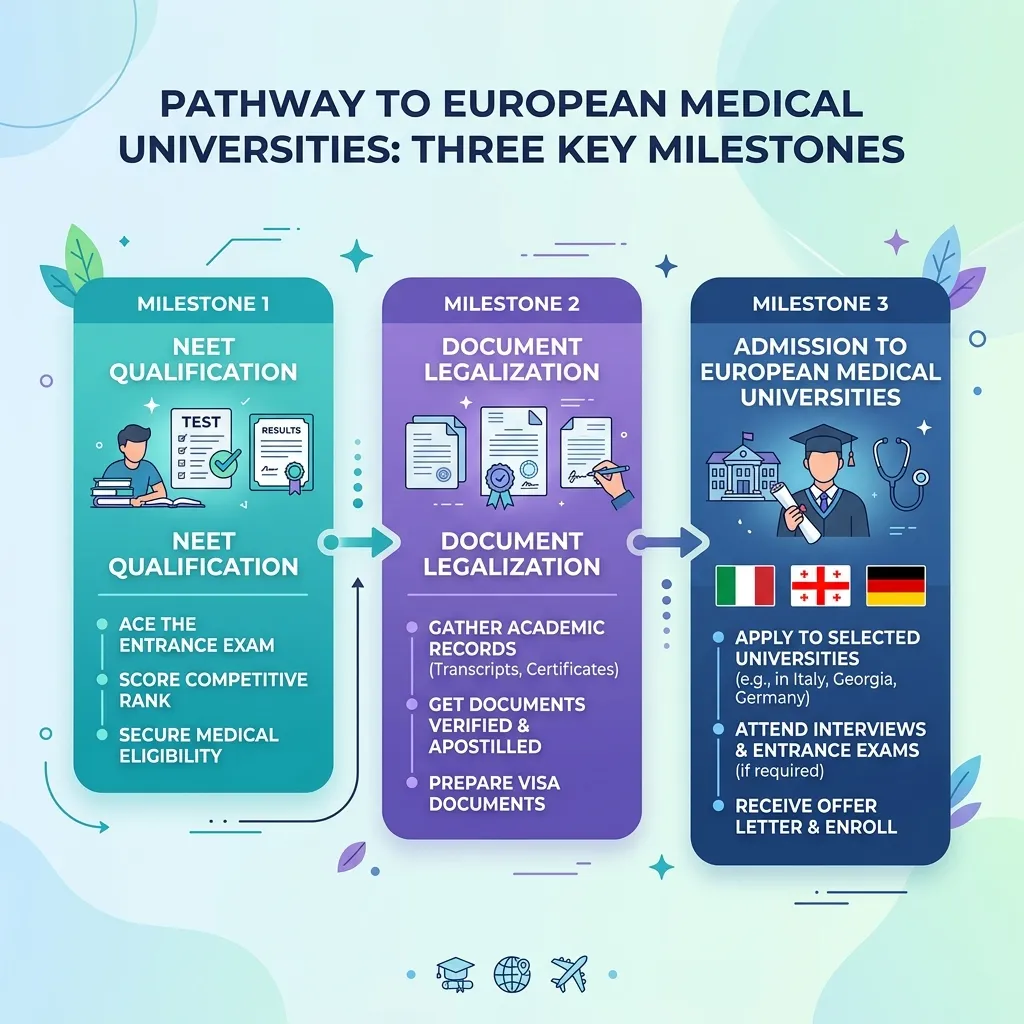
At Finesse Overseas, we operate a dedicated 360-Degree Compliance Audit Desk in India to guide you through every step of this journey:
[!TIP]
🛡️ The Finesse 360-Degree Guarantee
- Curriculum Mapping: We verify the academic hours of your chosen university against the NMC FMGL 2021 guidelines before you pay any fee.
- Consular Translation Pipeline: We manage the entire MEA Apostille and sworn Italian translation pipeline via consular-empaneled experts.
- Scholarship Management: We manage your ISEE Parificato calculations and CAF portal uploads to secure your €7,400 to €8,400 annual grants in Italy.
Do not let rank inflation or compromised exams delay your medical career. Contact our experts today to audit your academic profile and secure a compliant, world-class medical seat in Europe.
Take Control of Your Medical Future Today
- Explore the Complete MBBS in India vs Abroad Blueprint 2026: Compare NEET score cutoffs, transparent budgets, and NMC 54+12 compliance side-by-side.
- Visit Kolhapur Counseling Headquarters: Meet Jayant Patil sir in person at our overseas education consultants in Kolhapur Rajarampuri office for a transparent NEET score vs European MBBS feasibility audit.
- Download the Free NMC 2026 Sovereign Audit Kit: Access verified compliance checklists, links to sovereign university portals, and certified cost structures for 100% compliant European medical universities.
- Book a Free 1-on-1 Profile Audit: Speak directly to our senior placement strategists to map your NEET score to top-tier, fully compliant state-funded medical universities in Italy and Georgia.
Frequently Addressed Questions
01 What NEET UG score is legally required to study MBBS in Europe? +
To pursue MBBS abroad under NMC regulations, students do not need a high score (like 600+). You only need to qualify NEET by meeting the 50th percentile cutoff (typically around 130 to 140 marks out of 720).
02 How does the cost of a European MBBS compare to Indian private medical colleges? +
An NMC-compliant European MBBS (e.g. in Italy, Georgia, or Romania) costs between ₹20 Lakhs to ₹35 Lakhs total across all years, compared to ₹80 Lakhs to ₹1.2 Crore for private and deemed universities in India.
03 Are European medical degrees recognized in India after clearing the NExT exam? +
Yes. As long as the university satisfies the FMGL Regulations 2021 (54 months study + 12 months internship abroad + English medium), graduates are fully eligible to appear for the National Exit Test (NExT) and practice in India.
Verified Reference Sources & Statutory Citations
View Sources
Collapse
To satisfy stringent institutional due diligence and Google E-E-A-T standards, all figures, tuition rates, and legal frameworks in this investigation are cross-referenced with primary government registries:
Mr. Jayant Patil
Founder & CEOMr. Jayant Patil (Alumni of VJTI & JBIMS) is the Founder & CEO of Finesse Overseas Education with 22+ years of leadership in European higher education, German public admissions, and sovereign NMC compliance.
Official Guidance & Admission Blueprint
Get audited counseling, sovereign document verification, and zero-donation admissions through Finesse.
Related Sovereign Audits
 NMC Alerts
 Trapped in the NEET 2026 Re-Exam Loop? The Mental and Financial Toll on Middle-Class Indian Families
The cancellation of NEET UG 2026 due to paper leaks is a massive crisis. Understand the emotional toll, the financial audit of private Indian MBBS, and why a compliant European medical degree is a strategic sanity-saver.
 Study in Germany
 The Germany Tuition Fee Myth: Exposing the "Public Unis Are No Longer Free" Scam & The 14-State Zero-Tuition Matrix
Panicked by headlines that Germany is charging tuition fees? Discover the truth behind TUM and Baden-Württemberg, learn how local agents exploit this to push ₹15-Lakh private colleges, and access the definitive 14-state matrix where world-class public education remains 100% tuition-free.