
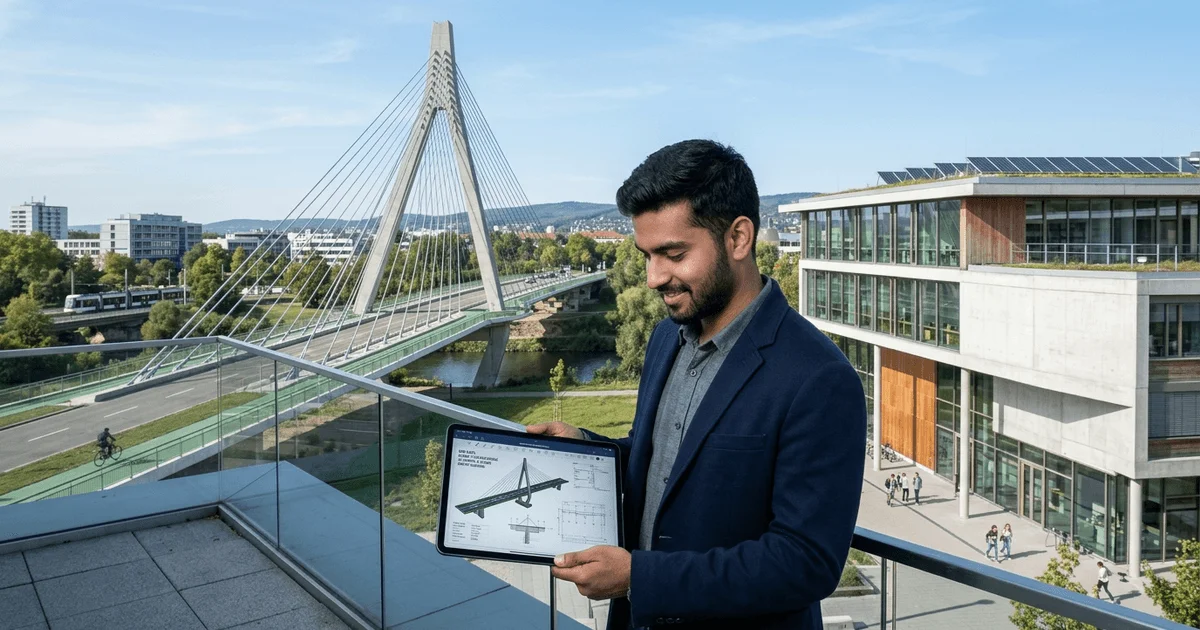
Executive Takeaways & Audited Summary
- €0 Tuition fees across public universities in 14 German federal states for international master's students.
- €11,904 mandatory Blocked Account living expense requirement for visa sponsorship.
- 18-month post-study job seeker and work visa allowing seamless transition into the EU job market.
- Average starting salaries exceeding €52,000 annually in advanced civil engineering and structural sectors.
For over 22 years operating out of our headquarters in Rajarampuri, Kolhapur, I have watched middle-class Maharashtrian parents mortgage farmland or liquidate ancestral properties to pay ₹25 Lakhs to ₹40 Lakhs a year for sub-standard, credit-card-funded degrees at private colleges in the UK or Canada. They fall prey to fly-by-night agents in Pune and Mumbai whose primary motivation is a 20% tuition commission kicked back by third-tier private institutions.
Let me state an uncompromising fact: if you possess a rigorous Bachelor of Engineering (B.E./B.Tech) in Civil Engineering from an AICTE-approved Indian institution, paying tuition fees for a Master's degree is an absolute financial blunder.
In Germany, 14 out of 16 federal states offer sovereign, public higher education with €0 tuition fees for consecutive Master of Science (M.Sc.) programs. You pay only modest semester contributions (ranging from €150 to €350 per semester), which almost universally include a public transit ticket (Semesterticket).
This comprehensive research guide provides the exact academic, mathematical, and legal blueprint required to transition from an engineering graduate in Western Maharashtra (Kolhapur, Sangli, Satara, Belgaum, Pune) to a fully matriculated M.Sc. student at a prestigious German public university for the 2026/2027 intake.
1. The Economic Reality: Public vs. Private Higher Education in Europe
Let us look at the numbers objectively. Generic education agents love to push private business schools in Germany or low-tier universities in English-speaking nations because state universities pay zero commissions.
The financial divergence between studying at a German public university versus a fee-charging private institution or traditional Western markets is stark:
| Financial & Structural Parameter | German Public University (TU9 / State U) | Private German College / UK / Canada |
|---|---|---|
| Annual Tuition Fees | €0 (Free across 14 federal states) | €12,000 to €35,000 per year |
| Living Expense Proof | €11,904/year (Blocked Account / Sperrkonto) | Variable, often front-loaded tuition + living |
| Degree Recognition | 100% State-accredited, globally elite (Anabin H+) | Varies; often unrecognised by German Chambers of Engineers (Ingenieurkammer) |
| Post-Study Work Visa | 18 Months (AufenthG § 16b) | 1 to 3 Years with strict labor market tests |
| Average Starting Salary | €52,000+ per year (Civil/Structural Sector) | Highly volatile, dependent on visa sponsorship |
| Agent Commission Influence | 0% (Sovereign public system) | 15% to 25% hidden commission built into marketing |
When you study structural or infrastructure engineering in Germany, you are not just escaping debt; you are entering a regulated European engineering ecosystem that strictly values institutional pedigree, ECTS compliance, and rigorous mathematical foundations.
2. Academic Prerequisites & ECTS Credit Matching for Civil Engineers
German public universities do not evaluate applications based on standard "admissions essays" or extracurricular certificates. Admissions are governed by strict, formulaic statutory regulations (Zulassungsordnung) embedded in state higher education laws.
If your Bachelor’s degree does not match the exact European Credit Transfer and Accumulation System (ECTS) credit thresholds set by the department faculty, your application will be automatically rejected by the uni-assist portal or university admissions office before a human even reads your statement of purpose.
Core Prerequisite Breakdown for Civil Engineering M.Sc.
- Mathematics and Mechanics (Minimum 30 ECTS Equivalent): German faculties require rigorous proof of coursework in Higher Mathematics (Calculus, Differential Equations, Linear Algebra), Engineering Mechanics (Statics, Strength of Materials / Mechanics of Materials, Dynamics). Indian degrees must clearly demonstrate equivalent hours in structural mechanics.
- Structural Design & Geotechnical Engineering (Minimum 15–20 ECTS): Coursework covering Reinforced Concrete Design, Steel Design, Soil Mechanics (Grundbau), and Foundation Engineering.
- Language Proficiency:
- English-Taught Programs: IELTS Academic minimum overall band of 6.5 (with no band under 6.0) or TOEFL iBT minimum score of 90.
- German-Taught Programs: DSH-2 or TestDaF (TDN 4 in all four sub-tests), alongside a recognized C1 Goethe-Zertifikat.
3. Mathematical Rigor: The Bavarian Grade Conversion Formula
Indian universities use percentage systems or CGPA scales (out of 10), whereas German universities utilize the Modified Bavarian Scale (Modifizierte Bayerische Formel) to evaluate academic standing.
Understanding this formula is critical because top-tier public universities (especially TU9 institutions like TU Stuttgart, RWTH Aachen, or TU Braunschweig) enforce strict cutoffs—often requiring a German equivalent of 2.3 or better (which roughly translates to an Indian aggregate of 70% to 75%+ from an autonomous or tier-1 university).
The Bavarian Grade Conversion Formula
📐 Modified Bavarian Formula:
German Grade (N) = 1 + 3 × [(Max Grade - Your Score) / (Max Grade - Passing Score)]
Where:
- x = German Grade (lower numerical value is better; 1.0 is "Sehr Gut", 4.0 is the minimum passing grade "Ausreichend").
- text{max_marks} = Maximum possible aggregate marks in your Indian B.E./B.Tech program (e.g., 100% or 10 CGPA converted to scale).
- text{obtained_marks} = Your final aggregate percentage or scaled GPA.
- text{min_passing_marks} = The absolute minimum passing threshold set by your Indian university (typically 40% or 4.0 CGPA).
At Finesse Kolhapur, we run this exact conversion algorithm for every student during our initial profile evaluation to ensure you only apply to universities where your academic profile clears the legal admission threshold.
4. The Mandatory APS Certificate Roadmap
Since November 2022, obtaining an Academic Evaluation Centre (APS - Akademische Prüfstelle) Certificate is a mandatory prerequisite for all Indian students applying for a German student visa or university admission. Without an APS certificate, your documents will not be processed by uni-assist or direct-application public universities.
Step-by-Step APS Execution Protocol
- Document Compilation:
- Class 10th and 12th mark sheets and passing certificates.
- Complete Bachelor of Engineering semester-wise mark sheets and final degree certificate (or provisional certificate if convocation is pending).
- University-issued medium of instruction letter and consolidated transcripts.
- Valid passport copy.
- Online Portal Registration: Register on the official APS India portal, pay the requisite verification fee (currently ₹18,000), and upload clear, color-scanned PDFs of all academic credentials.
- Verification & Forensic Audit: The APS conducts a rigorous background check, verifying authenticity directly with Indian autonomous universities and affiliating boards (e.g., Shivaji University Kolhapur, SPPU Pune, Mumbai University).
- Interview / Verification Phase: While many engineering files are cleared via document verification alone, the APS reserves the right to call candidates for a verification discussion.
- Timeline Reality: The standard APS turnaround time ranges between 6 to 8 weeks. Planning your intake must account for this buffer.
5. Financial Compliance: The €11,904 Blocked Account (Sperrkonto)
To satisfy German immigration laws (AufenthG § 16b), international students from non-EU countries must prove their financial self-sufficiency for the first year of their studies.
For the 2026/2027 intake, the statutory requirement for the Blocked Account (Sperrkonto) stands at €11,904 (calculated at €992 per month).
- How it works: You transfer €11,904 into a regulated German blocked account provider (such as Coracle, Expatrio, or Fintiba) before booking your visa appointment at the VFS Global center (Mumbai or Pune).
- Monthly Disbursement: Upon arrival in Germany and opening a local current account (Girokonto), the blocked account releases exactly €992 per month for your rent, health insurance (Krankenkasse), food, and living expenses.
- Working Rights: As an international student in Germany, you are legally permitted to work 140 full days or 280 half days per year, allowing you to earn supplementary income (€15–€20/hour as a student assistant / Hiwi at university institutes).
6. Verified Student Case Studies from Western Maharashtra
At Finesse Overseas Education, we measure our success not by marketing brochures, but by the sovereign public university admissions secured by students from Kolhapur, Sangli, Satara, and Pune.
Case Study 1: Rohit K. (Kolhapur Origin)
- Undergraduate Background: B.E. in Civil Engineering, Kolhapur.
- Admitted Program: M.Sc. Structural Engineering (Konstruktiver Ingenieurbau).
- University: TU Braunschweig (A premier TU9 associated institution).
- Result: Secured admission without conditional bridge modules; German student visa granted via VFS Mumbai within 3 weeks of APS submission. Rohit is currently completing his master's thesis in composite timber-concrete structures.
Case Study 2: Sneha P. (Pune / Satara Origin)
- Undergraduate Background: B.E. in Civil Engineering, Pune University.
- Admitted Program: M.Sc. Infrastructure Engineering.
- University: University of Stuttgart (Baden-Württemberg).
- Result: Successfully met the rigorous ECTS mathematics threshold. Visa granted with zero financial friction utilizing a standard German blocked account. Sneha is now working as a Graduate Structural Analyst in Frankfurt.
7. Anti-Scam Traps to Expose: Protecting Middle-Class Aspirants
The overseas education landscape is saturated with aggressive marketing agencies that exploit parental anxieties. Guard against these common predatory practices:
- Trap 1: The "Guaranteed German Admission" Private College Scam
- The Lie: Agents push students into private, unaccredited business or engineering schools in Germany charging €12,000+ per year, claiming public universities are "impossible to enter."
- The Finesse Reality: Public universities in Germany do not charge tuition and do not pay agent commissions. If an agency pushes a fee-charging private college in Germany, trace the financial incentive: they are collecting a direct commission from that private institution at your expense.
- Trap 2: Incomplete or Fraudulent APS Paperwork
- The Lie: Unverified agents rush document submissions or advise minor alterations on university transcripts to match credit thresholds.
- The Finesse Reality: The APS conducts forensic verifications with Indian examination controllers. Any discrepancy leads to an immediate rejection and blacklisting. Finesse experts—under VJTI and JBIMS alumni supervision—meticulously audit your transcripts against exact German credit equivalence before formal submission.
8. Step-by-Step Roadmap: Kolhapur to German Campus
- Phase 1: Profile Audit & ECTS Mapping (12–14 Months Before Intake) Visit our Kolhapur headquarters or schedule an online evaluation. We assess your B.E. transcripts, calculate your Bavarian grade, and map your math/mechanics ECTS credits.
- Phase 2: Language Mastery & Standardized Testing (10–12 Months Before Intake) Secure your IELTS Academic (6.5+) or TOEFL iBT (90+) score. If targeting bilingual or German-taught programs, complete your Goethe-Zertifikat C1.
- Phase 3: APS Certification (8–10 Months Before Intake) Submit your fully verified dossier to the APS India portal. Receive your digital APS certificate within 6 to 8 weeks.
- Phase 4: University Applications via Uni-Assist & Direct Portals (6–8 Months Before Intake) Apply to winter (Wintersemester – deadline typically July 15th) or summer (Sommersemester – deadline typically January 15th) intakes across TU9 and state public universities.
- Phase 5: Blocked Account & Visa Processing (3–5 Months Before Intake) Transfer the statutory €11,904 into your blocked account, secure mandatory public health insurance (Techniker Krankenkasse or AOK), and submit your visa application under AufenthG § 16b.
Consultation CTA
Stop paying exorbitant tuition fees to commission-driven agencies for mediocre foreign degrees. Build your engineering career on a sovereign, debt-free European foundation.
Book Your Profile Evaluation for Germany at Finesse Overseas Kolhapur HQ
Headquartered in Rajarampuri, Kolhapur, Maharashtra. Led directly by senior engineering and management alumni of VJTI Mumbai and JBIMS Mumbai with 22+ years of sovereign-compliant advisory experience. Let us evaluate your ECTS credits, calculate your Bavarian grade, and map your path to a zero-tuition German public university.
Frequently Asked Questions
01 Are tuition fees truly free for an MS in Civil Engineering in Germany? +
Yes, public universities in 14 German federal states charge €0 tuition fees for international students, with only nominal semester contributions ranging from €150 to €350 covering public transport tickets and administrative services.
02 What is the Bavarian Grade Conversion Formula used by German universities? +
German universities convert Indian percentages using the formula: x = 1 + 3 * ((max_marks - obtained_marks) / (max_marks - min_passing_marks)), where lower numerical values represent superior academic standing on the German 1.0 to 4.0 scale.
03 How does Finesse Kolhapur assist with the mandatory APS certification? +
Finesse Kolhapur experts meticulously verify academic transcripts, degree certificates, and board credentials as per German standards before official submission to avoid immediate rejections and streamline visa processing.
04 What are the financial requirements for the German student visa? +
Students must deposit €11,904 into a German Blocked Account (Sperrkonto) to demonstrate sufficient financial resources for living expenses during their first year of master's studies.
05 What post-study work opportunities are available after completing an MS in Civil Engineering? +
Graduates receive an 18-month post-study residence permit to seek employment related to their field, with structural and infrastructure engineering starting salaries averaging over €52,000 per year.
Verified Reference Sources & Statutory Citations
View Sources
Collapse
To satisfy stringent institutional due diligence and Google E-E-A-T standards, all figures, tuition rates, and legal frameworks in this investigation are cross-referenced with primary government registries:
Mr. Jayant Patil
Founder & CEOMr. Jayant Patil (Alumni of VJTI & JBIMS) is the Founder & CEO of Finesse Overseas Education with 22+ years of leadership in European higher education, German public admissions, and sovereign NMC compliance.
Official Guidance & Admission Blueprint
Get audited counseling, sovereign document verification, and zero-donation admissions through Finesse.
Related Sovereign Audits
 Study in Germany
MS in Digital Health & Medical Informatics in Germany (2026/2027): Zero-Tuition Public Universities Roadmap
Pursue MS in Digital Health & Medical Informatics in Germany. Zero-tuition public universities roadmap, APS guidance & visa rules by Finesse Kolhapur.
 Study in Germany
MS in Petroleum & Energy Engineering in Germany (2026/2027): Zero-Tuition Public Universities & APS Roadmap
Study MS in Petroleum & Energy Engineering in Germany with €0 tuition public universities. Get expert APS & blocked account guidance from Finesse Kolhapur.