
Executive Takeaways & Audited Summary
- Study at public German universities with €0 tuition fees for Electrical Power Engineering and Smart Grids.
- Mandatory APS India document authentication is required prior to applying to any German university.
- Financial proof requires maintaining an €11,904 blocked account for living expenses.
- Graduates enjoy high employment rates with an average starting salary of €58,000 per year.
For over 22 years sitting right here in Rajarampuri, Kolhapur, I have watched middle-class engineering families from Western Maharashtra—Kolhapur, Sangli, Satara, and Belgaum—fall prey to commission-hungry education agents. These fly-by-night operators push students into third-tier private business schools in London or substandard colleges in Canada simply because those institutions pay 20% to 30% back-channel commissions.
Let me state my stance plainly as an alumnus of VJTI Mumbai and JBIMS Mumbai: Not a single rupee of your hard-earned savings should ever go toward tuition fees for a master’s degree in engineering when Germany’s premier public sovereign universities offer world-class education for €0 tuition.
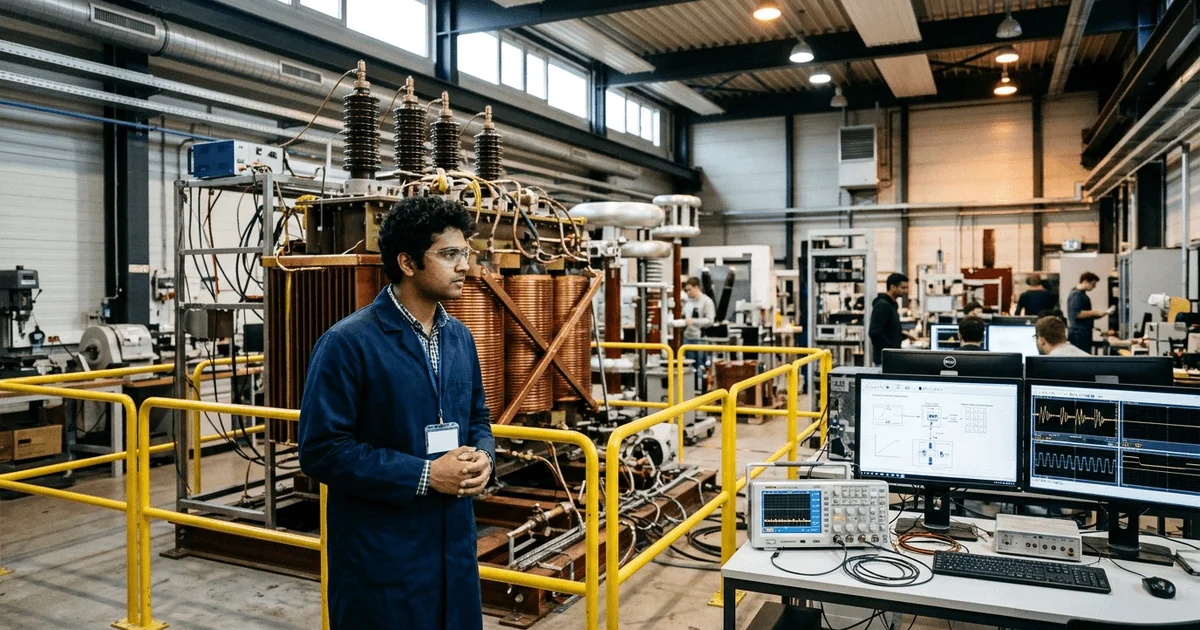
When you target an MS in Electrical Power Engineering Germany public universities, you are stepping into the heartland of the Energiewende—Germany’s historic transition to renewable energy, smart grids, and high-voltage direct current (HVDC) transmission. This comprehensive guide strips away the agent fluff, exposes the hidden traps, and lays down the exact mathematical, legal, and bureaucratic steps required to transition from a local engineering college in Maharashtra to a tuition-free lecture hall in Germany.
1. The Reality of Public Higher Education vs. Agent Scams
The German higher education model is funded by state taxpayers to foster industrial and technological capability, not to enrich middle-men. Across 14 federal states, public universities charge €0 tuition fees for consecutive master's programs. You pay only a nominal semester contribution (typically €250 to €350 per semester), which invariably includes a statewide public transport ticket (Semesterticket).
Anti-Scam Trap: The "Guaranteed Admission" Broker
- The Trap: Unscrupulous agents in Pune and Mumbai demand lakhs of rupees in "processing fees," claiming they have "special quotas" or "direct donation routes" into German public universities. They push students toward private, for-profit German colleges charging €12,000 to €15,000 per year—colleges that survive entirely on agent kickbacks and offer zero industrial recognition.
- The Sovereign Reality: German public universities do not have management quotas, donation seats, or agent tie-ups. Every application goes through an independent merit-based evaluation via the university portal or uni-assist.
- The Finesse Standard: At Finesse Overseas Education in Kolhapur, we charge transparent counseling fees, file directly through official sovereign portals, and ensure you apply exclusively to state-funded public institutions.
2. Core Academic & Financial Metrics for 2026/2027
To successfully secure an admission seat and a German student visa under AufenthG § 16b, your profile must withstand rigorous screening. Below are the definitive benchmarks for the 2026/2027 intake cycles.
| Metric | Sovereign Requirement / Specification |
|---|---|
| Tuition Fees (Public Universities) | €0 per semester across non-fee federal states (e.g., North Rhine-Westphalia, Bavaria, Baden-Württemberg administrative fees apply). |
| Minimum Academic Eligibility | B.E. / B.Tech in Electrical Engineering, Electrical & Electronics, or Power Systems with ≥ 7.0 CGPA. |
| Bavarian Formula Equivalent | ≤ 2.5 German grade limit (top 25% admission ratio). |
| Language Proficiency | English-taught programs: IELTS Academic 6.5 overall (no band < 6.0) or TOEFL iBT 90+. |
| Mandatory Verification | Academic Evaluation Centre (APS India) certificate before university submission. |
| Blocked Account Requirement | €11,904 per year (€992/month) deposited into an authorized German blocked account provider (e.g., Coracle, Expatrio). |
3. Mathematical & Legal Rigor: The Bavarian Formula
German admissions committees do not read Indian marksheets at face value. They convert your percentage or CGPA into the strict Bavarian Grading Scale (Modifizierte Bayerische Formel) to establish academic equivalence.
Critical Formula: Bavarian Grade Conversion
📐 Formula:
text{German Grade} = 1 + 3 × ≤ft[ frac{text{Max. Possible Grade} - text{Student's Grade}}{text{Max. Possible Grade} - text{Passing Grade}} right]
Practical Application for an Autonomous University in Maharashtra:
- Max. Possible Grade: 10.0 CGPA
- Passing Grade: 4.0 CGPA
- Student's Cumulative Grade: 8.5 CGPA
📐 Formula:
text{German Grade} = 1 + 3 × ≤ft[ [10.0 - 8.5 / 10.0 - 4.0] right] = 1 + 3 × ≤ft[ [1.5 / 6.0] right] = 1 + 0.75 = 1.75
A calculated German grade of 1.75 easily clears the strict ≤ 2.5 cutoff mandated by top-tier institutions like RWTH Aachen, TU Munich, and Universität Stuttgart for electrical power engineering.
4. The Mandatory APS India Roadmap
Before you can dispatch a single document to a German university, you must clear the Akademische Prüfstelle (APS) India hurdle. Established jointly by the German Embassy and the DAAD, APS verifies the authenticity of your school leaving certificates, Bachelor’s degree marksheets, and university transcripts.
Step-by-Step APS Execution Protocol:
- Online Registration: Create an account on the official APS India portal and pay the verification fee (currently INR 18,000).
- Document Dossier Preparation: Compile notarized copies of your 10th standard board certificate, 12th standard/Diploma certificate, all semester marksheets, provisional/degree certificate, and English language scorecards (IELTS/TOEFL).
- Courier Submission: Dispatch the physical dossier to the APS office in New Delhi.
- Verification Window: For the 2026 intake cycles, expect an average turnaround of 30 to 45 days from dossier receipt to certificate issuance. Never wait for your final semester results to start this process; apply as soon as your 6th or 7th-semester transcripts are in hand.
5. Financial Engineering: Living Expenses & The Blocked Account
While tuition is free, the German government requires proof of financial self-sufficiency under AufenthG § 16b to issue your student residence permit.
The €11,904 Blocked Account Reality
Effective for current visa regulations, students must deposit €11,904 into a blocked account (Sperrkonto) prior to visa stamping at the VFS Global center in Mumbai.
- Monthly Disbursement: You are permitted to withdraw up to €992 per month for rent, health insurance, food, and semester living expenses.
- Part-Time Work Rights (Nebenjob): Under German labor law, international students are legally permitted to work 140 full days or 280 half days per year. At a standard student wage of €14 to €16 per hour (student assistants or Hiwi roles at university institutes), working part-time easily covers your living costs, preserving your blocked capital.
6. Target Public Universities for M.Sc. Electrical Power Engineering
Not all electrical master's programs are created equal. You must target universities possessing dedicated high-voltage laboratories, smart grid simulation centers, and direct R&D partnerships with industrial giants like Siemens Energy, ABB, Schneider Electric, and TenneT.
- RWTH Aachen University
- Program: M.Sc. Electrical Engineering, Information Technology and Computer Engineering (Major: Electrical Power Engineering).
- Profile: Home to the Institute for High Voltage Technology (IFHT) and Institute for Power Generation and Storage Systems (PGS). Highly competitive; strictly requires GRE or specialized technical entrance exams depending on module credits.
- Universität Stuttgart
- Program: M.Sc. Electrical Engineering (Focus on Smart Grids and Renewable Integration).
- Profile: Deeply integrated with regional automotive and power electronics manufacturers in Baden-Württemberg.
- TU Dortmund University
- Program: M.Sc. Electrical Engineering and Information Technology (Power Systems track).
- Profile: Renowned for power system stability analysis, protection engineering, and high-voltage substation design.
- Otto von Guericke University Magdeburg
- Program: M.Sc. Electrical Power Engineering.
- Profile: Exceptionally industry-aligned with manageable living costs in Saxony-Anhalt.
7. Verified Student Case Study: From Kolhapur to Aachen
+-----------------------------------------------------------------+
| STUDENT DOSSIER: ADITYA KULKARNI                                |
| Origin: Kolhapur, Maharashtra                                   |
| Academic Background: B.E. Electrical Engineering (Shivaji Univ) |
| CGPA: 8.8 (Bavarian Equivalent: 1.5)                            |
| Target Program: M.Sc. Electrical Power Engineering, RWTH Aachen |
| Visa Processing Time: Approved in 3 Weeks                       |
+-----------------------------------------------------------------+
Aditya walked into our Finesse Rajarampuri office in Kolhapur with an 8.8 CGPA from an affiliated college under Shivaji University, Kolhapur. Like many middle-class parents, his father—a retired state government employee—was terrified of hidden costs and visa rejections.
We executed a rigorous profile roadmap:
- APS Dossier Optimization: Filed his paperwork cleanly, ensuring absolute numerical matching between his university grading scales and the APS requirements.
- Bavarian Conversion Alignment: Highlighted his core electrical power subjects (Transmission & Distribution, Switchgear & Protection, Electrical Machines) to satisfy RWTH Aachen’s strict ECTS credit mapping.
- Blocked Account Setup: Guided him through setting up his digital blocked account without incurring exorbitant wire-transfer markups.
- Visa Interview Coaching: Prepared him thoroughly for his VFS Mumbai appointment under AufenthG § 16b.
Aditya received his German student visa in just 3 weeks without a single query from the consulate. Today, he is completing his master's thesis in high-voltage DC transmission systems while working as a student research assistant (Wissenschaftliche Hilfskraft) at an institute in North Rhine-Westphalia.
8. Step-by-Step Strategic Roadmap for 2026/2027 Applicants
If you are currently an engineering student or graduate in Western Maharashtra, follow this chronological execution framework:
[Month 1-2] Academic Audit & Language Prep
   │
   ▼
[Month 3-4] APS India Documentation & Submission
   │
   ▼
[Month 5-6] ECTS Mapping & University Selection
   │
   ▼
[Month 7-8] Portal Applications (uni-assist / Direct)
   │
   ▼
[Month 9-10] Admission Offer Acceptance & Blocked Account Setup
   │
   ▼
[Month 11-12] VFS Visa Lodgment & Departure for Germany
- Phase 1 (Months 1–2): Audit your undergraduate transcript. Ensure you have completed at least 20 to 30 ECTS credits (or equivalent Indian semester hours) in core mathematics, electromagnetic fields, and classical power systems. Start your IELTS or TOEFL preparation immediately.
- Phase 2 (Months 3–4): Gather all academic records, prepare notarized copies, and dispatch your file to APS India to secure your verification certificate.
- Phase 3 (Months 5–6): Select 4 to 6 tuition-free public universities matching your ECTS profile. Draft an uncompromised, technically rigorous Statement of Purpose (SOP) detailing your academic alignment with smart grid topologies or power electronics.
- Phase 4 (Months 7–8): Submit applications directly via university portals or uni-assist before the summer/winter deadlines (typically July 15 for Winter intake and January 15 for Summer intake).
- Phase 5 (Months 9–10): Secure your university admission letter (Zulassungsbescheid), transfer funds into your blocked account, and purchase mandatory public health insurance (gesetzliche Krankenversicherung).
- Phase 6 (Months 11–12): Book your VFS Global appointment in Mumbai, clear your visa interview, and book your flight to Frankfurt or Düsseldorf.
Conclusion & Actionable Next Steps
Studying electrical power engineering in Germany is not a distant dream reserved for the elite; it is a mathematical and administrative reality built for disciplined engineering graduates. Do not let uninformed agents derail your career with predatory commissions and overpriced private college scams.
Get your transcripts evaluated by professionals who understand both the intricacies of German higher education law and the aspirations of middle-class families in Maharashtra.
Schedule your Free Profile Evaluation today at Finesse Overseas Rajarampuri Kolhapur HQ. Let us build your sovereign-compliant roadmap to a debt-free engineering career in Europe.
Frequently Asked Questions
01 What are the tuition fees for an MS in Electrical Power Engineering in Germany? +
Public state universities in most German states charge €0 tuition fees, requiring only a nominal semester contribution of €250 to €350 which often includes public transport tickets.
02 What is the APS India mandate for studying in Germany? +
The Academic Evaluation Centre (APS) India certificate is mandatory for all Indian student applicants. It authenticates school and university academic documents before you can apply to German universities.
03 How much money is required in the German blocked account for 2026/2027? +
Students must deposit €11,904 into a blocked account (Sperrkonto) as financial proof to secure their German student visa for living expenses.
04 How is the Bavarian Formula used for German university admissions? +
The Bavarian Formula calculates your Indian grade equivalence: 1 + 3 * [(Max_Grade - Student_Grade) / (Max_Grade - Passing_Grade)]. A lower score indicates a better German grade equivalent.
05 What is the average starting salary after completing an MS in Electrical Power Engineering in Germany? +
Graduates entering the German energy and smart grid sector command an average starting salary of approximately €58,000 per year.
Verified Reference Sources & Statutory Citations
View Sources
Collapse
To satisfy stringent institutional due diligence and Google E-E-A-T standards, all figures, tuition rates, and legal frameworks in this investigation are cross-referenced with primary government registries:
Mr. Jayant Patil
Founder & CEOMr. Jayant Patil (Alumni of VJTI & JBIMS) is the Founder & CEO of Finesse Overseas Education with 22+ years of leadership in European higher education, German public admissions, and sovereign NMC compliance.
Official Guidance & Admission Blueprint
Get audited counseling, sovereign document verification, and zero-donation admissions through Finesse.
Related Sovereign Audits
 Study in Germany
MS in Digital Health & Medical Informatics in Germany (2026/2027): Zero-Tuition Public Universities Roadmap
Pursue MS in Digital Health & Medical Informatics in Germany. Zero-tuition public universities roadmap, APS guidance & visa rules by Finesse Kolhapur.
 Study in Germany
MS in Petroleum & Energy Engineering in Germany (2026/2027): Zero-Tuition Public Universities & APS Roadmap
Study MS in Petroleum & Energy Engineering in Germany with €0 tuition public universities. Get expert APS & blocked account guidance from Finesse Kolhapur.