
Executive Takeaways & Audited Summary
- Study at German public state universities with €0 tuition fees for your M.Sc. in Embedded Systems & VLSI Design.
- Maintain an €11,904 blocked account in Deutsche Bank or Expatrio to fulfill mandatory German student visa financial proof.
- Target semiconductor engineering hotspots like Munich, Stuttgart, and Dresden with starting packages from €60,000 to €75,000/year.
- Get transparent, merit-based processing and APS guidance under the expert mentorship of VJTI & JBIMS alumni at Finesse Kolhapur.
For over 22 years operating out of our Rajarampuri headquarters in Kolhapur, I have sat across the desk from brilliant engineering graduates and their middle-class parents from Western Maharashtra—Kolhapur, Sangli, Satara, Belgaum, and Pune. The narrative I hear every single day is identical: “Sir, local agents in Pune and Mumbai are telling us to pay ₹15 lakhs to ₹20 lakhs for a private UK university or a questionable German private business school offering an MS in management or generic IT.”
Let me state this with the absolute authority of a VJTI Mumbai and JBIMS Mumbai alumnus: Paying tuition fees for an engineering master’s degree in Europe, let alone Germany, is a financial and professional miscalculation.
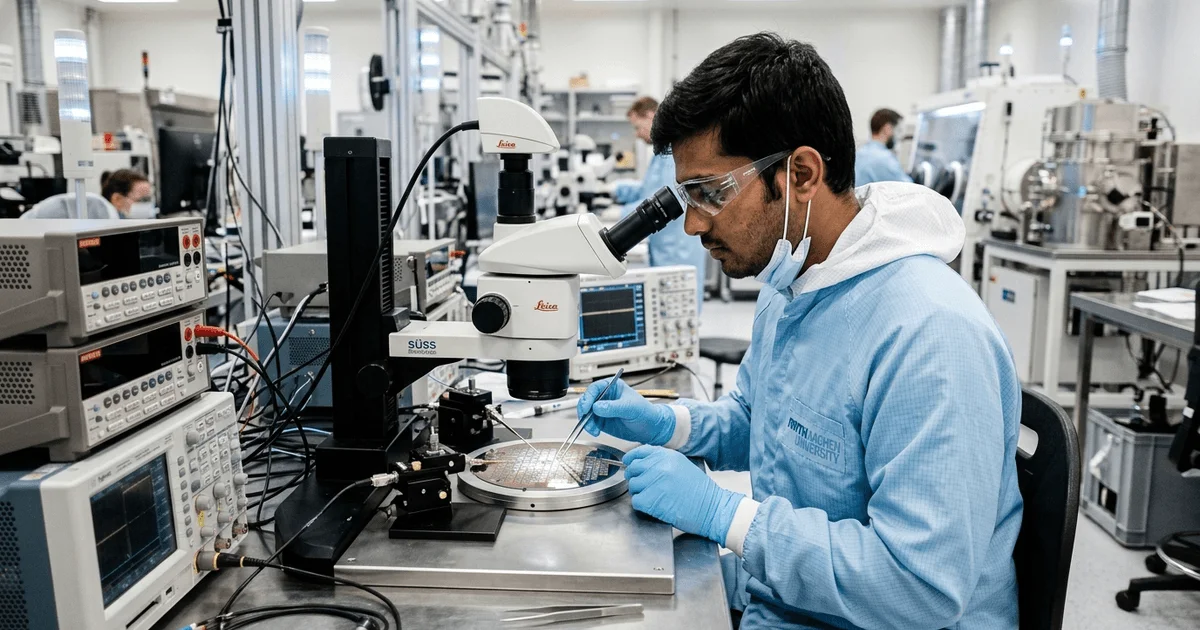
Germany remains the undisputed epicenter of European semiconductor manufacturing, automotive electronics, and embedded systems engineering. With the European Union enacting the €43 billion European Chips Act and massive semiconductor hubs flourishing in Dresden (Silicon Saxony), Munich, Stuttgart, and Frankfurt, the demand for trained microelectronics engineers, Verilog/VHDL design specialists, and embedded software architects has never been higher.
Public state universities in Germany charge €0 tuition fees for consecutive master’s programs. You do not need to mortgage your ancestral farmland in Kolhapur or take predatory private loans with exorbitant interest rates. You need mathematical precision, academic rigor, sovereign compliance, and zero-agent fluff.
This roadmap outlines how an electronics engineer from Maharashtra secures admission to an English-taught MS in Embedded Systems and VLSI Germany public universities, navigates the APS India certification, clears the Bavarian grade conversion formula, and steps onto a German technical university campus without paying a single rupee of agent commission to predatory consultants.
The Economics of Zero-Tuition vs. Agent Scams
The overseas education market is infested with commission-driven operators who push students into low-tier private institutions in the UK, Canada, or private German "universities of applied sciences" that charge €12,000 to €15,000 per year in tuition. Why? Because those private institutions pay 15% to 20% commission kickbacks to the agent sitting in an air-conditioned office in Mumbai or Pune.
When you walk into Finesse Overseas Education in Rajarampuri, Kolhapur, our philosophy is rooted in public and sovereign systems. We despise these shortcuts.
Exposing Common Admission Traps
| Trap Set by Unscrupulous Agents | The Sovereign Reality & Finesse Solution |
|---|---|
| Paying lakhs of rupees for "guaranteed admission seats" in public German universities. | Public German universities (Universitäten and Technische Universitäten) do not have paid seats or management quotas. Admissions are strictly merit-based via Uni-Assist or direct university portals. Finesse charges zero consultancy fees for public university admissions. |
| Fake English waiver certificates or bypassing the Academic Evaluation Centre (APS India) verification process. | Bypassing APS or submitting fraudulent language certificates results in immediate, permanent visa bans under German immigration law (AufenthG). Finesse’s Kolhapur team manages complete document notarization, VFS tracking, and direct APS file preparation. |
| Pushing private business schools for technical students under the guise of "easier visa processing." | Private business schools offer zero engineering value, trap students in debt, and offer poor employment prospects in the core German engineering sector. We steer you exclusively toward TU9 and state-funded Technische Universitäten. |
Academic Prerequisites & Core Competencies for 2026/2027
German public technical universities do not evaluate your profile based on how much money you can pay; they evaluate you strictly on your ECTS credit equivalence, core subject matches, and undergraduate academic performance.
For an MS in Embedded Systems or VLSI Design, the admissions committee at universities like TU Munich, TU Dortmund, University of Stuttgart, or FAU Erlangen-Nürnberg will scrutinize your B.E./B.Tech transcripts in Electronics and Communication Engineering (ECE), Electrical Engineering (EE), or Instrumentation.
Mandatory Academic Baseline
- Undergraduate CGPA: Minimum 7.5+ CGPA on a 10-point scale (converts to a strong German grade under the modified Bavarian formula).
- Core Technical Stack: Proficiency in C and C++ for embedded firmware, Verilog/VHDL/SystemVerilog for hardware description and FPGA design, Digital Signal Processing (DSP), Computer Architecture, and Microcontroller/Microprocessor interfacing (ARM Cortex, RISC-V).
- Language Proficiency:
- English-Taught Programs: IELTS Academic minimum overall 6.5 (with no band under 6.0) or TOEFL iBT minimum 90.
- German-Taught Programs (Rare for core VLSI, but possible): TestDaf TDN 4 or DSH-2.
- Mandatory Sovereign Certification: APS India Certificate (Akademische Prüfstelle). Without this verification from New Delhi, no German consulate will accept your visa application.
Mathematical Rigor: The Bavarian ECTS Conversion Formula
German universities evaluate international degrees using the Modified Bavarian Formula to convert Indian university percentage systems or 10-point CGPA scales into the German grading scale (where 1.0 is the best possible grade and 4.0 is the minimum passing grade).
Critical Formula 1: Bavarian ECTS Conversion Formula
📐 Formula:
text{German Grade} = 1 + 3 × ( frac{text{Max_Scale} - text{Grade}}{text{Max_Scale} - text{Min_Passing}} )
- Max_Scale: 10.0 (for Indian CGPA systems) or 100% (for percentage systems).
- Min_Passing: 4.0 (for CGPA) or 40% (for percentage).
- Grade: Your cumulative undergraduate CGPA or percentage.
Practical Calculation Example:
If an electronics engineering graduate from Shivaji University Kolhapur or Pune University achieves a cumulative 8.5 CGPA:
📐 Formula:
text{German Grade} = 1 + 3 × ( [10.0 - 8.5 / 10.0 - 4.0] ) = 1 + 3 × ( [1.5 / 6.0] ) = 1 + 3 × 0.25 = mathbf{1.75}
A German grade of 1.75 is classified as “Gut” (Good) to “Sehr Gut” (Very Good), making the student highly competitive for top-tier TU9 embedded systems programs.
Financial Architecture & Sovereign Visa Compliance
While tuition is €0 at public universities across 14 German federal states (excluding minor semester contribution fees of €250 to €350 per semester that include public transport tickets), the German Federal Foreign Office requires proof of living expenses via a blocked account (Sperrkonto).
Critical Formula 2: NMC & Visa Financial Proof (Blocked Account)
📐 Formula:
text{Annual Blocked Account Requirement} = €11,904 text{ (or } €992text{/month)}
Under Section 16b of the Residence Act (AufenthG § 16b), students must deposit this amount into a blocked account with providers like Deutsche Bank, Expatrio, or Coracle before visa issuance to prove subsistence without public recourse.
Comprehensive Financial Breakdown for Year 1
| Expense Category | Amount in Euros (€) | Amount in INR (Approx. @ ₹92/€) |
|---|---|---|
| Tuition Fees (Public State Universities) | €0 | ₹0 |
| Semester Contributions (Includes Transit Ticket) | €300 - €700 / year | ₹27,600 - ₹64,400 |
| Blocked Account (Living Expenses) | €11,904 | ₹10,95,168 |
| Health Insurance (TK / AOK statutory insurance) | ~€1,440 / year | ~₹1,32,480 |
| Flight & Initial Setup Costs | ~€1,000 | ~₹92,000 |
| Total Initial Outlay Required | ~€14,644 | ~₹13,47,248 |
Compare this ₹13.5 lakh first-year outlay (which remains entirely under your control for living expenses) against a £25,000 (~₹26 Lakhs) tuition-only private UK university bill, and the fiscal wisdom of public German education becomes undeniable.
Admission Trends & Timelines for 2026/2027 Intake
| Metric | Specification |
|---|---|
| Target Intake Year | 2026 / 2027 |
| Admission Selectivity Ratio | Top 15% (Strict credit matching in Mathematics, C Programming, and Hardware Description Languages) |
| Instruction Language | 100% English-Taught across major Embedded & VLSI programs |
| Average APS India Turnaround Time | 6 Weeks (Requires meticulous semester-wise transcript mapping) |
Step-by-Step Roadmap from Kolhapur to German Campus
- Month 1-3 (Skill & Language Audit): Complete IELTS/TOEFL preparation. Build robust academic projects in Verilog on FPGA boards (Basys 3 or ZedBoard) and deep embedded C on ARM Cortex-M microcontrollers.
- Month 4-5 (APS India Dossier Preparation): At Finesse Kolhapur HQ, our documentation experts verify your university marksheets, degree certificates, and school leaving certificates for direct submission to the APS New Delhi portal.
- Month 6-7 (University Shortlisting & Uni-Assist): Select exact public universities offering English-taught M.Sc. in Embedded Systems / Microelectronics. Submit applications via Uni-Assist or direct university portals (AlmaWeb, CAMPUSonline).
- Month 8-9 (Admission Letters & Blocked Account): Receive Zulassungsbescheid (Admission Letter). Open your blocked account via Expatrio or Deutsche Bank and deposit €11,904.
- Month 10 (VFS Global Visa Submission): File your student visa application under AufenthG § 16b at the Mumbai VFS center with biometric enrollment.
- Month 11-12 (Departure & Enrollment): Fly to Germany, complete city registration (Anmeldung), enroll at the university registrar’s office, and join the thriving Indian engineering student community.
Verified Student Case Studies from Western Maharashtra
At Finesse Overseas Education, our results speak through our students currently engineering the future across European research labs and semiconductor giants.
Case Study 1: Siddharth Kulkarni (Kolhapur Origin)
- Degree Pursued: M.Sc. Embedded Systems Engineering
- University: TU Dortmund University
- Background: B.E. ECE from a Kolhapur engineering college (8.8 CGPA)
- Visa Result: Visa Granted in 3 Weeks (Winter Intake)
- Jayant Patil’s Note: “Siddharth came to our Rajarampuri office confused by commercial agents pushing him toward expensive UK universities. We mapped his microprocessors and RTOS coursework to TU Dortmund’s strict credit requirements. Today, he is working part-time as a Student Assistant (HiWi) at an embedded research institute in North Rhine-Westphalia.”
Case Study 2: Tanvi Deshmukh (Pune Origin)
- Degree Pursued: M.Sc. Microelectronics & Microsystems
- University: University of Freiburg
- Background: B.Tech Electrical Engineering (9.1 CGPA)
- Visa Result: Visa Granted on First Attempt
- Jayant Patil’s Note: “Tanvi had an exceptional academic record but lacked clarity on APS documentation protocols. Our team structured her transcripts precisely to match Freiburg’s analog and mixed-signal IC design prerequisites. She paid zero tuition fees and is now targeting internship opportunities in Munich's semiconductor corridor.”
Career ROI & Semiconductor Industry Salaries in Germany
Graduating with an MS in Embedded Systems or VLSI Design from a German public technical university positions you directly inside Europe's most lucrative engineering sector. Germany is home to global semiconductor and automotive giants including Infineon Technologies, Bosch, Siemens, NXP Semiconductors, AMS Osram, and GlobalFoundries (Dresden).
- Entry-Level Semiconductor/Embedded Engineer Salaries: €60,000 to €75,000 per year gross in industrial hubs like Munich, Stuttgart, Frankfurt, and Dresden.
- Working Student (Werkstudent) Opportunities: Students are legally permitted to work 140 full days or 280 half days per year, easily earning €18 to €25 per hour during their master’s studies to cover living expenses independently.
- Permanent Residency (Niederlassungserlaubnis): Graduates of German public universities can apply for permanent residency after just 21 months of working in a qualified engineering role while holding a B1 German language certificate (or 27 months with basic A1 proficiency) under AufenthG § 18c.
Schedule Free 1-on-1 Profile Evaluation for MS in Embedded Systems at Finesse Kolhapur HQ
Do not let commission-driven agents compromise your engineering career with overpriced private degrees. Benefit from 22+ years of sovereign-compliant advisory backed by VJTI and JBIMS alumni rigor.
Visit our Kolhapur Headquarters: Finesse Overseas Education Rajarampuri, Kolhapur, Maharashtra. (Direct personal consultations available by prior appointment for students and parents across Kolhapur, Sangli, Satara, Belgaul, and Pune).
Frequently Asked Questions
01 What are the tuition fees for an MS in Embedded Systems and VLSI Germany public universities? +
Public state universities in Germany charge €0 tuition fees for international students, though a nominal semester contribution ranging from €150 to €350 is required, which often includes public transport tickets.
02 How much is the blocked account requirement for a German student visa? +
You must deposit €11,904 into a blocked account (Sperrkonto) with authorized providers like Deutsche Bank or Expatrio to demonstrate financial self-sufficiency for your visa issuance.
03 What is the Bavarian ECTS Conversion Formula used by German technical universities? +
German TUs use the formula: 1 + 3 * ((Max_Scale - Grade) / (Max_Scale - Min_Passing)) to strictly convert Indian engineering percentage transcripts to the German grading scale.
04 What salary can I expect after graduating with an MS in VLSI from Germany? +
Entry-level semiconductor and embedded systems engineering packages in innovation hubs like Munich, Stuttgart, and Dresden typically average between €60,000 and €75,000 per year.
05 How does Finesse Overseas Education in Kolhapur assist with public university admissions? +
Led by VJTI & JBIMS alumni, Finesse charges zero consultancy fees for public university admissions, managing complete document verification, Bavarian grade conversions, and APS India file preparation.
Verified Reference Sources & Statutory Citations
View Sources
Collapse
To satisfy stringent institutional due diligence and Google E-E-A-T standards, all figures, tuition rates, and legal frameworks in this investigation are cross-referenced with primary government registries:
Mr. Jayant Patil
Founder & CEOMr. Jayant Patil (Alumni of VJTI & JBIMS) is the Founder & CEO of Finesse Overseas Education with 22+ years of leadership in European higher education, German public admissions, and sovereign NMC compliance.
Official Guidance & Admission Blueprint
Get audited counseling, sovereign document verification, and zero-donation admissions through Finesse.
Related Sovereign Audits
 Study in Germany
MS in Digital Health & Medical Informatics in Germany (2026/2027): Zero-Tuition Public Universities Roadmap
Pursue MS in Digital Health & Medical Informatics in Germany. Zero-tuition public universities roadmap, APS guidance & visa rules by Finesse Kolhapur.
 Study in Germany
MS in Petroleum & Energy Engineering in Germany (2026/2027): Zero-Tuition Public Universities & APS Roadmap
Study MS in Petroleum & Energy Engineering in Germany with €0 tuition public universities. Get expert APS & blocked account guidance from Finesse Kolhapur.