
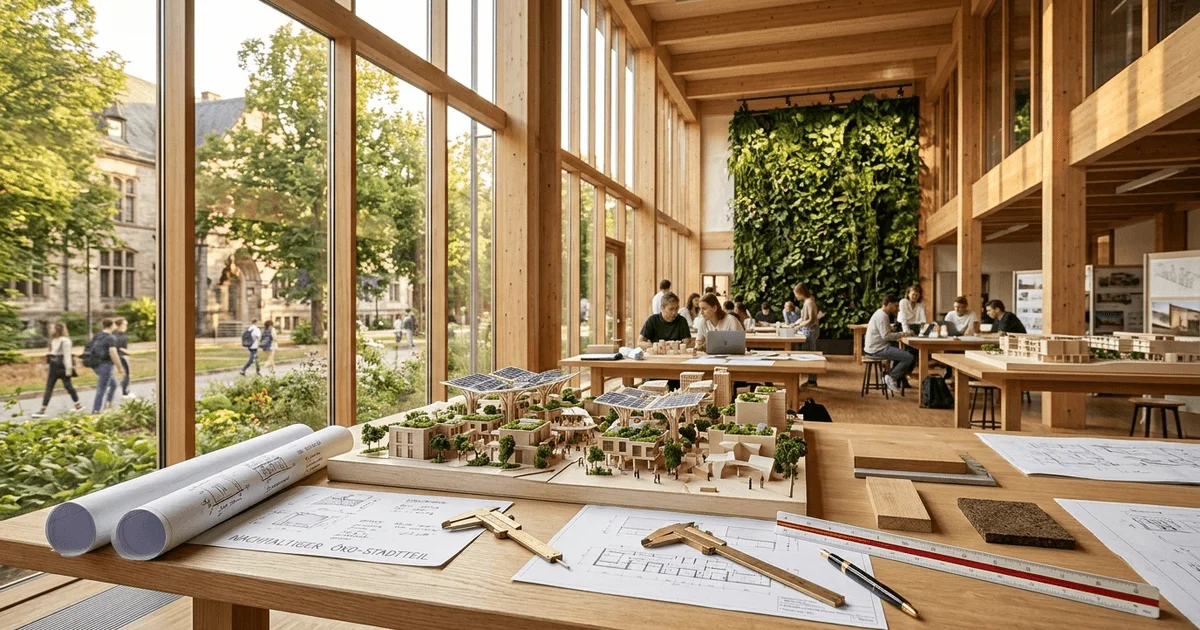
Executive Takeaways & Audited Summary
- Zero Tuition Fees: Access tuition-free M.Sc. programs across 14 sovereign German public states.
- Financial Proof: Maintain a mandatory blocked account threshold of €11,904 (€992/month) for visa approval.
- Lucrative ROI: Secure green building sector starting salaries ranging between €48,000 and €60,000 per year.
- Critical Compliance: Complete mandatory APS India document verification early to avoid university rejection.
Every admission season across Western Maharashtra—whether a student walks into our Rajarampuri headquarters in Kolhapur from Rankala, or arrives from Sangli, Satara, and Belgaum—I encounter the same predictable deception. High-street education agents operating in Pune and Mumbai flood local newspapers and Instagram feeds with glossy advertisements promising "Direct Admission to German Engineering & Architecture Colleges" for fee packages running into lakhs of rupees. They herd middle-class engineering and architecture graduates toward private, unaccredited corporate business schools or third-rate private design academies charging €12,000 to €18,000 per academic year. Why? Because those private institutions pay them a 15% to 20% backroom commission.
Let me state this with the absolute authority of a VJTI Mumbai structural engineering alumnus and a JBIMS management graduate who has spent over 22 years steering students toward sovereign pathways: In 14 German federal states, public universities charge ZERO tuition fees for consecutive Master's programs—including specialized degrees in Sustainable Architecture and Urban Design. You do not pay a single Euro to the state for your education. You pay only a nominal semester contribution (€250 to €350), which almost universally includes regional public transport passes (the Deutschlandticket).
If you are paying an agent a massive fee to secure admission into a private German design school, you are being exploited. This manual provides the complete, sovereign-compliant blueprint for securing an MS in Sustainable Architecture Germany public universities for the 2026/2027 intakes, stripping away agency fluff and replacing it with mathematical formulas, legal statutes, and rigorous academic strategy.
1. The Real Economics: Public vs. Private Architecture Schools in Germany
Middle-class parents in Maharashtra often ask me: "Sir, if public universities charge zero tuition, how do German universities sustain themselves?"
The answer lies in the constitutional funding model of the Federal Republic of Germany. Higher education is treated as a public infrastructure good, funded by state tax revenues (Landesmittel), not a commercial commodity.
Let us examine the stark financial reality through an empirical comparison over a standard 4-semester (2-year) Master of Science program:
| Financial Metric | Sovereign Public Universities (e.g., TU Berlin, Stuttgart, Leibniz Universität Hannover) | Private Commercial Business & Design Schools (Disguised Private Academies) |
|---|---|---|
| Tuition Fees (per semester) | €0 (Zero tuition across 14 federal states) | €6,000 to €9,500 (€12,000 to €19,000 per year) |
| Total Program Tuition (2 Years) | €0 | €24,000 to €38,000 |
| Semester Contributions | €250 – €350 / semester (includes transit) | €250 – €500 / semester |
| Mandatory Blocked Account (Sperrkonto) | €11,904 / year (€992 / month as per German Federal Foreign Office) | €11,904 / year |
| Degree Recognition | Full accreditation via ASIIN / AQAS; direct pathway to Architektenkammer (Chamber of Architects) registration | Frequently lack chamber recognition, restricting independent architectural practice in Germany |
| Agent Commission Incentive | 0% (Public institutions pay zero commissions to agents) | 15% to 20% kickbacks paid to high-street Indian agencies |
When you examine these numbers, the predatory nature of commission-driven agencies becomes glaringly obvious. They steer students away from elite state institutions because public universities do not pay agent commissions. At Finesse Overseas Education in Kolhapur, our advisory fee is transparent and professional; we do not accept back-channel institutional payouts, ensuring our allegiance remains strictly with the student and their family.
2. Academic Prerequisites & The Bavarian Grade Conversion Formula
Securing a seat in an MS in Architecture Germany public universities program requires meeting rigorous academic and technical criteria. German admission committees do not look at your CGPA through the lens of Indian grading systems. They utilize a strict mathematical translation known as the Bavarian Formula (Modifizierte Bayerische Formel) to convert Indian university percentage systems or 10-point CGPA scales into the German grading scale (where 1.0 is exceptional and 4.0 is the minimum passing grade, usually requiring a 2.5 or better for competitive Master's programs).
The Critical Formulas
1. Bavarian Grade Conversion Formula
📐 Modified Bavarian Formula:
German Grade (N) = 1 + 3 × [(Max Grade - Your Score) / (Max Grade - Passing Score)]
Where:
- text{max_grade}: The maximum possible grade in the Indian grading system (e.g., 10.0 CGPA or 100%).
- text{achieved_grade}: Your cumulative GPA or final percentage (e.g., 8.2 CGPA).
- text{passing_grade}: The minimum grade required to pass in your Indian university (e.g., 4.0 CGPA or 40%).
Admissions offices at uni-assist and individual TU9 universities run this formula programmatically. If your converted Bavarian grade does not meet the cutoff (typically 2.3 or better for top-tier urban design programs), your application is rejected before a human even opens your portfolio. This is why targeting universities based on a mathematical assessment of your profile—rather than random guessing—is non-negotiable.
2. Blocked Account Threshold
📐 Formula:
text{Annual Proof of Financial Sustenance} = €11,904 quad (text{Structured as } €992 / text{month})
Mandated by the German Federal Foreign Office under Aufenthaltsgesetz (Residence Act) § 16b for visa issuance. This proves you can sustain your living expenses (rent, health insurance, food, books) without relying on restricted local part-time work rights (which are capped at 140 full days or 280 half days per year).
Core Academic Checklist for Applicants
- Undergraduate Degree: A recognized Bachelor of Architecture (B.Arch) or a closely related B.E. in Civil Engineering / Urban Planning (minimum 4-year undergraduate degree yielding 240 ECTS credits).
- Minimum GPA: Generally a minimum 7.0/10 CGPA, translating roughly to a 2.3–2.5 Bavarian grade.
- Design Portfolio: Mandatory for Sustainable Architecture and Urban Design tracks. It must showcase studio projects, urban analysis, CAD/BIM proficiency (AutoCAD, Revit, Rhino, Grasshopper), and hand-drafting or physical model-making skills.
- Language Proficiency:
- English-Taught Tracks: IELTS Academic (minimum 6.5 overall with no band under 6.0) or TOEFL iBT (minimum 90).
- German-Taught Tracks: TestDaF (minimum TDN 4 in all sections) or DSH-2 (required for programs like TU Berlin's urban planning tracks if taught partially in German).
- APS India Certification: Mandatory administrative clearance by the Academic Evaluation Centre (Akademische Prüfstelle) in New Delhi before university submission or visa stamping.
3. Admission Trends & The 2026/2027 Landscape
| Metric | 2026/2027 Projection | Institutional Reality |
|---|---|---|
| Admission Selectivity Ratio | Top 15% | High competition; DAAD-linked programs receive over 1,200 international applicants for 40 seats. |
| English-Taught Availability | 85% | Majority of specialized Master's in Sustainable Architecture/Urban Design are conducted fully in English. |
| Average APS Turnaround Time | 30 Days | Streamlined compared to previous years, but prone to backlogs if documents lack proper university verification seals. |
Anti-Scam Trap #1: Private School Deceptions
- The Trap: High-street agents attempting to convince parents that "public universities have a 2-year waiting list," pushing them instead toward private German design schools charging €15,000 per year.
- The Finesse Solution: We map your academic profile directly to sovereign, state-funded public universities (such as TU Berlin, Leibniz Universität Hannover, Bauhaus-Universität Weimar, and TU Dortmund) operating under the legal frameworks of the 14 states offering zero tuition.
Anti-Scam Trap #2: Delaying APS India Certification
- The Trap: Waiting until university application portals (uni-assist or direct university VPD portals) close before applying for the mandatory APS certificate, resulting in immediate administrative rejection.
- The Finesse Solution: At our Kolhapur headquarters, we initiate your APS document verification audit the moment you enroll with our advisory, ensuring your certificate is secured months before application windows open.
4. Step-by-Step Roadmap: From Kolhapur to German Campus
Navigating the transition from Western Maharashtra to a European lecture hall requires strict adherence to timelines and regulatory checkpoints.
[Month 1-3: Profile Audit & GPA Conversion]
       │
       ▼
[Month 4-5: Portfolio Building & IELTS/TOEFL Prep]
       │
       ▼
[Month 6: Mandatory APS India Verification Filing]
       │
       ▼
[Month 7-8: University Selection & uni-assist / VPD Submission]
       │
       ▼
[Month 9-10: University Admission Offer & Blocked Account Setup]
       │
       ▼
[Month 11-12: VFS Global Visa Filing (AufenthG § 16b) & Departure]
Phase 1: Mathematical Profile Audit & Strategy (Months 1–3)
We sit down at our Rajarampuri office in Kolhapur to evaluate your undergraduate transcripts using the Bavarian formula. We identify whether your B.Arch or B.E. meets the exact 210 or 240 ECTS credit requirements mandated by German state examination regulations (Prüfungsordnung).
Phase 2: Portfolio Enhancement & Language Exams (Months 4–5)
German architecture schools do not care about your extracurricular certificates; they evaluate your spatial reasoning, ecological sensitivity, and technical documentation skills. We mentor you on structuring your digital portfolio to European architectural standards (A4/A3 landscape, clear analytical diagrams, energy-efficiency workflows, and climate-responsive design methodologies). Simultaneously, clear your IELTS Academic or TOEFL.
Phase 3: APS India Document Authentication (Month 6)
Your marksheets, degree certificates, 10th/12th board certificates, and university transcripts must be submitted to the APS office in New Delhi. Finesse experts verify every stamp, transcript format, and university contact detail to prevent audit queries that stall applications.
Phase 4: University Selection & Application via uni-assist (Months 7–8)
We target top-tier public programs such as:
- TU Berlin: M.Sc. Urban Design / M.Sc. Architecture Typology
- Bauhaus-Universität Weimar: M.Sc. Media Architecture / M.Sc. Urbanism
- Leibniz Universität Hannover: M.Sc. Architecture and Urban Design
- TU Dortmund: M.Sc. Urban Planning and Territorial Development
- Stuttgart State Academy of Art and Design / Universität Stuttgart: Integrated sustainable building design tracks.
Applications are processed either via uni-assist (charging €75 for the first university and €30 for each subsequent choice) or directly through university portals via VPD (Vorprüfungsdokument) evaluation.
Phase 5: Visa Processing under AufenthG § 16b (Months 9–12)
Upon receiving your official university admission letter (Zulassungsbescheid), we guide you through depositing €11,904 into a regulated blocked account provider (such as Coracle, Expatrio, or Fintiba), securing statutory or private health insurance (Krankenversicherung like TK or AOK), and booking your VFS Global visa appointment in Mumbai or Pune.
5. Verified Student Case Study: From Kolhapur to Berlin
To demonstrate that sovereign pathways are entirely accessible to dedicated students from regional Maharashtra, examine this verified case from our active advisory records:
- Student Name: Tanvi K.
- Origin: Kolhapur (Rajarampuri resident, completed B.Arch from a regional Maharashtrian university).
- Degree Program Secured: M.Sc. Sustainable Urban Design, Technische Universität Berlin (TU Berlin).
- Academic Profile: 8.4 CGPA (Bavarian Equivalent: 1.8), IELTS 7.5, 60-page professional design portfolio.
- Financial Structure: €0 Tuition Fees; €11,904 Blocked Account maintained via Coracle.
- Visa Result: Student Visa granted under § 16b in exactly 3 weeks via VFS Mumbai.
Tanvi’s journey proves that you do not need to spend lakhs on private foreign colleges or fall prey to agency commission tricks. With rigorous academic preparation, precise grade conversion, and strict adherence to sovereign regulations, doors to world-class education open naturally.
6. Career ROI & Post-Graduation Realities in Germany
An MS in Sustainable Architecture and Urban Design from a German public university positions you at the forefront of Europe’s green transition (Energiewende). Under German building regulations (such as the Gebäudeenergiegesetz - GEG), energy-efficient retrofitting and carbon-neutral urban planning are mandatory growth sectors.
Employment & Salary Outlook
- Starting Salaries: Graduates entering architectural practices, urban planning firms, or energy-consulting engineering bureaus in Frankfurt, Berlin, Munich, or Stuttgart typically command starting salaries between €48,000 and €60,000 per year.
- Post-Study Work Visa: Upon graduation, you receive an 18-month job seeker visa (Aufenthaltserlaubnis zur Suche eines Arbeitsplatzes under § 20 Abs. 3. 3 AufenthG) to secure full-time employment.
- Permanent Residency Pathway: After securing employment and contributing to the statutory pension scheme (Deutsche Rentenversicherung) for 2 years while holding an EU Blue Card (or 3 to 4 years under standard employment permits), you become eligible to apply for a Settlement Permit (Niederlassungserlaubnis), and eventually German citizenship.
Schedule Your Consultation
Stop gambling your career and your family's hard-earned savings on commission-driven education agencies. Build your international future on mathematical precision, legal compliance, and zero-tuition sovereign public education.
Schedule Free Consultation at Finesse Kolhapur HQ (Rajarampuri)
- Address: Finesse Overseas Education, Rajarampuri, Kolhapur, Maharashtra.
- Advisory Focus: Profile Evaluation, Bavarian Grade Conversion, APS Verification Mapping, and Zero-Tuition University Selection.
Frequently Asked Questions
01 Are German public universities completely free for an MS in Sustainable Architecture? +
Yes, public universities in 14 German states charge zero tuition fees for master's degree programs. Students only pay a nominal semester contribution (€150 to €350) which frequently includes public transport tickets.
02 What is the Bavarian Grade Conversion Formula used for? +
German uni-assist and public architecture schools use the formula x = 1 + 3 * [(max_grade - achieved_grade) / (max_grade - passing_grade)] to evaluate Indian university percentages and CGPA systems into the German 1.0 to 5.0 grading scale.
03 Why is the APS India certificate mandatory for my German university application? +
The Academic Evaluation Centre (APS) certificate authenticates your Indian academic credentials and is a mandatory prerequisite for all German university admissions and student visa processing.
04 What is the current blocked account requirement for German student visas? +
As per German Federal Foreign Office guidelines, the mandatory blocked account financial threshold is €11,904 per year, which calculates to €992 per month for living expenses.
05 What are the post-graduation salary expectations in Germany for sustainable architects? +
Graduates specializing in sustainable architecture and urban design typically secure high starting salaries ranging from €48,000 to €60,000 per year within Germany's expanding green building and urban planning sectors.
Verified Reference Sources & Statutory Citations
View Sources
Collapse
To satisfy stringent institutional due diligence and Google E-E-A-T standards, all figures, tuition rates, and legal frameworks in this investigation are cross-referenced with primary government registries:
Mr. Jayant Patil
Founder & CEOMr. Jayant Patil (Alumni of VJTI & JBIMS) is the Founder & CEO of Finesse Overseas Education with 22+ years of leadership in European higher education, German public admissions, and sovereign NMC compliance.
Official Guidance & Admission Blueprint
Get audited counseling, sovereign document verification, and zero-donation admissions through Finesse.
Related Sovereign Audits
 Study in Germany
MS in Digital Health & Medical Informatics in Germany (2026/2027): Zero-Tuition Public Universities Roadmap
Pursue MS in Digital Health & Medical Informatics in Germany. Zero-tuition public universities roadmap, APS guidance & visa rules by Finesse Kolhapur.
 Study in Germany
MS in Petroleum & Energy Engineering in Germany (2026/2027): Zero-Tuition Public Universities & APS Roadmap
Study MS in Petroleum & Energy Engineering in Germany with €0 tuition public universities. Get expert APS & blocked account guidance from Finesse Kolhapur.